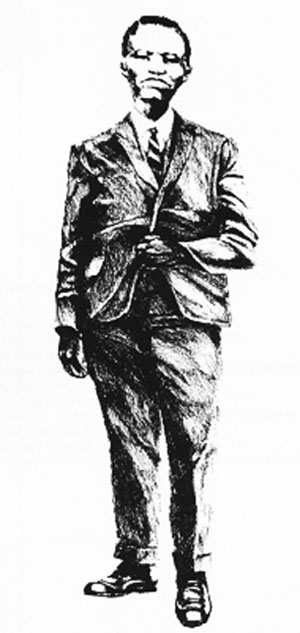
T.W. Thibedi, radical school-teacher, was a leading figure in the anarchist / syndicalist International Socialist League (ISL) and the revolutionary syndicalist Industrial Workers of Africa (IWA) union. He was involved in late 1910s struggles, like the March-April 1919 anti-pass law campaign on the Witwatersrand. The campaign had been driven by more radical members of the Transvaal ANC — including members of the revolutionary ISL and IWA, like Fred Cetiwe and Hamilton Kraai. But the campaign was called off by conservative leaders of the South African Native National Congress (now the African National Congress, ANC).
The Heroic Story of the Industrial and Commercial Workers’ Union of Africa (ICU): learning the lessons
Compiled by Warren McGregor (TAAC, ZACF)
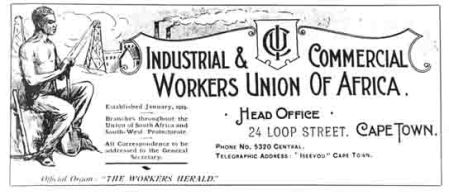
The Industrial and Commercial Workers’ Union of Africa (ICU) was formed in Cape Town in 1919. In 1920 it merged with the revolutionary syndicalist union, the Industrial Workers of Africa, and other unions. It grew rapidly in South Africa among Coloured and black African workers and tenant farmers. It also spread, in the 1920s and 1930s, into neighbouring countries. The ICU was not a revolutionary syndicalist union, but it was influenced by syndicalism.

What were the aims of the ICU?
The aims of the ICU were sometimes a little confused. It was influenced by many ideas. But according to the 1925 Constitution of the ICU, and many speeches and statements, the ultimate aim of the ICU was: to abolish the class system through worker and direct action, and to equally redistribute economic and political power, in conjunction with organised workers throughout the world.
Why is it important to build an anarchist political organisation
Anarchism is a socialist ideology aiming to bring about a radical change, involving getting rid of the state and capitalism. We aim to change the current economic system that is backed up by state officials, and based on maximizing the profits of the elite few.
We the majority, are currently victims of our fate and mere pawns in ruling class economic and political games, but it does not have to stay like that. We want a world based on freedom, liberation, anti-authoritarianism and anti-statism: a world free of all forms of domination, capitalism and the state.
Sharing this ideal is one of the most important requirements for joining the anarchist movement. We want to build a non-hierarchical stateless society that will rise through a revolution, from the ground up. What we need is a free society, not a declaration of freedom but freedom from the reality of a class-divided society.
Westonaria wastes R1.5 million on legal fees
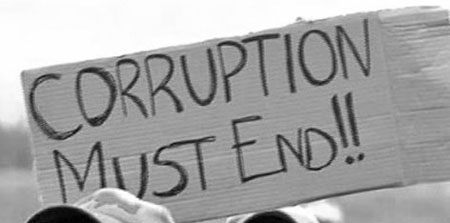
Westonaria municipality wasted R1.5 million on legal fees (October 2007 to August 2012) trying to fire a VIP protection officer who spoke out against tender irregularities.
Tumisani Mnguni, a former cadre of the MK armed group, was employed by Westonaria municipality in March 2007 as a VIP protector. In October, he was appointed as head of the VIP protection public safety unit by Mr Seitischo, the then-Westonaria municipal manager.
But Mnguni was fired after challenging the municipality’s decision to award tenders worth millions of Rands to outside companies without following proper procedures. In July 2009, Mnguni had reported the matter to the Premier of Gauteng, the MEC for Local Government and Housing, and the Office of the Public Protector.
The R1.5 million was spent on hiring outside lawyers to pursue its case against Mnguni.
These payments were made between December 2010 and April 2011 to a Pretoria-based law firm, called De Swart-Vogel-Myambo Attorneys. R308 856 was paid in December 2010 for 24 months, covering salary and traveling costs for this law firm.
The expensive legal battle took place while the municipality struggled to provide township residents with basic services such as refuse removal, water, sanitation and electricity due to lack of funding.
What are your rights?
Although the Constitution protects the rights of whistle-blowers, and we have laws that are meant to promote their rights (such as the Protected Disclosures Act), in reality there is not much protection for whistle-blowers and such people face huge challenges.
For example, people who “blow the whistle” on their employers often lose their jobs (even though the law says you cannot be fired for whistle-blowing). Sometimes the corrupt person will say the whistle-blower has broken the law and hire a lawyer to threaten them, or take them to court. Sometimes whistleblowers have even been hurt or killed!
South Africa’s whistleblowers are being targeted, intimidated and silenced.
We must stand with them!
Cosatu used to pump millions of Rands to support the ANC’s election campaigns
At the Congress of South Africa Trade Unions (Cosatu) media briefing on Thursday 21 November 2013, its president Sdumo Dlamini told a journalist that the federation is “yet to decide” whether or not to contribute financially toward the ANC’s 2014 election campaign. The briefing followed a Cosatu central executive committee (CEC) meeting.
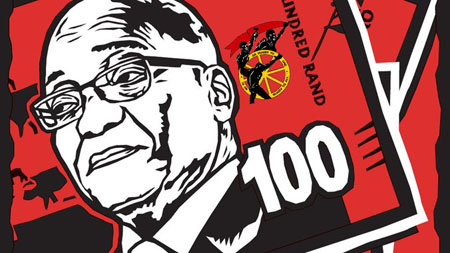
But according to the Cosatu treasurer’s report, Cosatu budgeted R8 million for the 2014 ANC election campaign!
Khutsong Community fights Gangsters
by Mzee (TAAC)
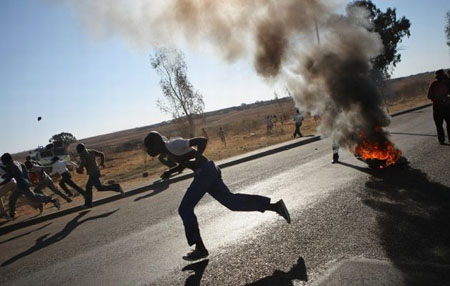
Members of the community of Khutsong chanted struggle songs, and demonstrated outside the Oberholzer Magistrate’s Court on the 14 January 2014. They were in support of fellow community members arrested following an infamous incident of mob justice that occurred in Khutsong in 2013. This mob justice led to the death of five people believed to be gangsters, and of one traditional healer to the gangsters. The gangsters had terrorised the community.
The community members were arrested in 2013, but the court hearing was remanded to 14 January 2014 for the bail applications, which were granted. Jack Magagabe, Willy Jongilanga, Andrew Langa, Happy Leyakane and Metsela Kgosane are being charged on twelve counts, including public violence, destruction of public property, murder and arson. The accused are being represented by a pro-bono (free) advocate.
More than 85 flying squad police cars were deployed in Khutsong in late 2013 on a “peace-keeping” mission. Many cases of police brutality were reported by the community. The township of Khutsong is not happy with how the police have been handling matters so far.
Khutsong: Pre-emptive “crime-stopping” leads to police brutality
by Bongani Maponyane (TAAC, ZACF)
Khutsong has not been at peace, facing a high police deployment, supposedly to combat crime. The government was adamant about cleaning up the streets in Khutsong. This followed certain brutal crimes.
Police Rapid Response Teams were put in place, monitoring the usage of alcohol and drugs, and the illegal trade in goods, to try to combat and eradicate crime. The Technical Response Team was also a big part of the crime bust.
The Khutsong Tragedy
Residents in Khutsong location were neglected by the police many times, and that is why they ended up taking the law into their own hands in late 2013.
It all started when gang members killed some people, and cut off their body parts. Some then killed each other too. When the gang members attended the funeral of their fellow members, the police escorted them to the graveyard. But the gang members managed to rob people of their belongings on the way to the graveyard — in front of the police. The South African Police Services (SAPS) is failing us.
Soon after the incidents, many police were deployed to raid the location. But they arrested many innocent people for nothing, yet the gangsters remained free.
In South Africa the police are among the ones doing crime. As we have seen in the past, our senior police officials have been facing corruption charges, including two former National Commissioners, Jackie Selebi and Bheki Cele. And look what happened at Marikana, but the current police Commissioner Riah Phiyega is defending the acts of the police in the massacre.
The police shoot people, so it is clear that the police are against us. They are not here to defend us in our new so-called democracy.
Obituary of Ousi Lawrence Zitha
by Nobuhle Dube (TAAC)
Comrade Lawrence was born on 7 July 1969 in Kliptown before moving to Ceza in KwaZulu-Natal. He attended Ceza Primary and Nghunghunyone Secondary, matriculating in 1986 with exemption (excellent at that time).
He was employed by Nampak Polyfoil as a factory worker until 2006. He was an activist, and became involved with anarchism in 2011.
He passed away on 13 June 2013, suffering from chronic kidney failure. He is survived by his mother Johanna Zitha, two brothers (Jaby and Bongane Zitha) and his sister (Gladness Zitha), not forgetting his nieces and nephews.
May he rest in peace.