The International Socialist League: laying the foundations

The International Socialist League: laying the foundationsCompiled by Warren McGregor (TAAC, ZACF)

What was the ISL and what were its aims?

The International Socialist League (ISL) was a revolutionary syndicalist political organisation founded in Johannesburg in 1915. Many founders were militants who had broken from the South African Labour Party (SALP) over its support for the British Imperial war effort in World War I. They were opposed to capitalist war and imperialism.

The ISL aimed to organise “One Big Union” of the entire South African working class to fight for the overthrow of capitalism and the taking over of society by the working class, for the working class.

What did the ISL say about race?

Key to this project in the South African context was the breaking of the racial divisions within the working class. This required raising the specific demands of black workers for equality with white workers, in order to practically unite all workers and to enable them to work together toward “their common emancipation from wage slavery.”

Continue reading

T.W. Thibedi and the Industrial Workers of Africa, April-July 1919

T.W. Thibedi and the Industrial Workers of Africa, April-July 1919by Lucien van der Walt

T.W. Thibedi, radical school-teacher, was a leading figure in the anarchist / syndicalist International Socialist League (ISL) and the revolutionary syndicalist Industrial Workers of Africa (IWA) union. He was involved in late 1910s struggles, like the March-April 1919 anti-pass law campaign on the Witwatersrand. The campaign had been driven by more radical members of the Transvaal ANC — including members of the revolutionary ISL and IWA, like Fred Cetiwe and Hamilton Kraai. But the campaign was called off by conservative leaders of the South African Native National Congress (now the African National Congress, ANC).

Continue reading

The Heroic Story of the Industrial and Commercial Workers’ Union of Africa (ICU): learning the lessons

Compiled by Warren McGregor (TAAC, ZACF)

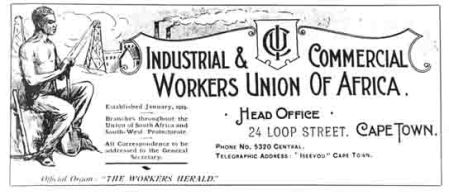
The Industrial and Commercial Workers’ Union of Africa (ICU) was formed in Cape Town in 1919. In 1920 it merged with the revolutionary syndicalist union, the Industrial Workers of Africa, and other unions. It grew rapidly in South Africa among Coloured and black African workers and tenant farmers. It also spread, in the 1920s and 1930s, into neighbouring countries. The ICU was not a revolutionary syndicalist union, but it was influenced by syndicalism.

The Workers Herald - ICU

What were the aims of the ICU?

The aims of the ICU were sometimes a little confused. It was influenced by many ideas. But according to the 1925 Constitution of the ICU, and many speeches and statements, the ultimate aim of the ICU was: to abolish the class system through worker and direct action, and to equally redistribute economic and political power, in conjunction with organised workers throughout the world.

Continue reading

Why is it important to build an anarchist political organisation

Why is it important to build an anarchist political organisationby Bongani Maponyane (TAAC)

Anarchism is a socialist ideology aiming to bring about a radical change, involving getting rid of the state and capitalism. We aim to change the current economic system that is backed up by state officials, and based on maximizing the profits of the elite few.

We the majority, are currently victims of our fate and mere pawns in ruling class economic and political games, but it does not have to stay like that. We want a world based on freedom, liberation, anti-authoritarianism and anti-statism: a world free of all forms of domination, capitalism and the state.

Sharing this ideal is one of the most important requirements for joining the anarchist movement. We want to build a non-hierarchical stateless society that will rise through a revolution, from the ground up. What we need is a free society, not a declaration of freedom but freedom from the reality of a class-divided society.

Continue reading

Westonaria wastes R1.5 million on legal fees

Westonaria wastes R1.5 million on legal feesby Mzee (TAAC)

Westonaria municipality wasted R1.5 million on legal fees (October 2007 to August 2012) trying to fire a VIP protection officer who spoke out against tender irregularities.

Tumisani Mnguni, a former cadre of the MK armed group, was employed by Westonaria municipality in March 2007 as a VIP protector. In October, he was appointed as head of the VIP protection public safety unit by Mr Seitischo, the then-Westonaria municipal manager.

But Mnguni was fired after challenging the municipality’s decision to award tenders worth millions of Rands to outside companies without following proper procedures. In July 2009, Mnguni had reported the matter to the Premier of Gauteng, the MEC for Local Government and Housing, and the Office of the Public Protector.

The R1.5 million was spent on hiring outside lawyers to pursue its case against Mnguni.

These payments were made between December 2010 and April 2011 to a Pretoria-based law firm, called De Swart-Vogel-Myambo Attorneys. R308 856 was paid in December 2010 for 24 months, covering salary and traveling costs for this law firm.

The expensive legal battle took place while the municipality struggled to provide township residents with basic services such as refuse removal, water, sanitation and electricity due to lack of funding.