Obituary of Ousi Lawrence Zitha

Orbituary of Ousi Lawrence Zithaby Nobuhle Dube (TAAC)

Comrade Lawrence was born on 7 July 1969 in Kliptown before moving to Ceza in KwaZulu-Natal. He attended Ceza Primary and Nghunghunyone Secondary, matriculating in 1986 with exemption (excellent at that time).

He was employed by Nampak Polyfoil as a factory worker until 2006. He was an activist, and became involved with anarchism in 2011.

He passed away on 13 June 2013, suffering from chronic kidney failure. He is survived by his mother Johanna Zitha, two brothers (Jaby and Bongane Zitha) and his sister (Gladness Zitha), not forgetting his nieces and nephews.

May he rest in peace.
Download Issue #3 of the Newsletter of the Tokologo African Anarchist Collective

Tokologo #3 cover

Click above picture to download Issue #3 of Tokologo,
the Newsletter of the Tokologo African Anarchist Collective

Editorial

Welcome to issue 3 of “Tokologo,” produced by members of the Tokologo African Anarchist Collective, based in Gauteng, South Africa. Our members come from Johannesburg, Khutsong, Sebokeng, and Soweto; we are committed to the fight for the full freedom of the working class and poor, in South Africa and abroad. We do not want privatisation (capitalist ownership), we do not want nationalisation (state ownership), we want self-management and socialisation (community/ worker ownership), of land and all other productive resources.

Continue reading

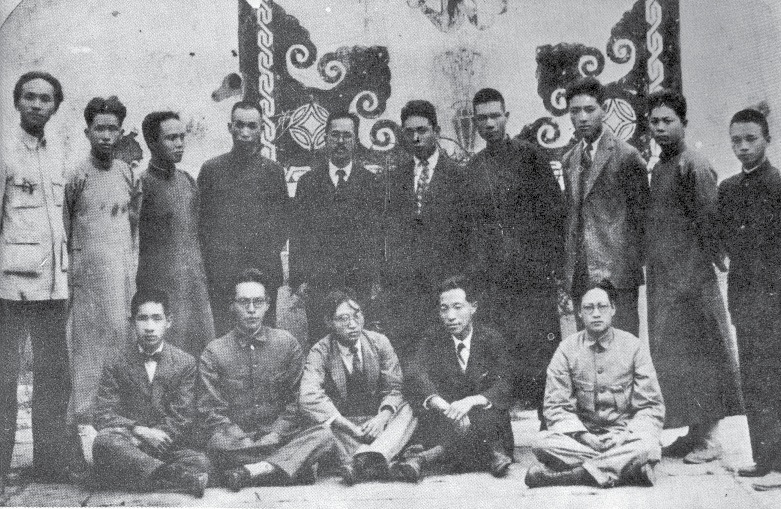
The Story of the Korean Anarchists and the Anarchist Revolution in Manchuria, 1929-1931

Korean anarchistsThe Korean anarchist movement wanted to build an independent self-governing anarchist society, a cooperative system of the masses of the Korean people. They wanted to take civilisation from the capitalist class, and return it to the popular classes. By doing so, the capitalist and colonial society that existed in Korea (as elsewhere in Africa and Asia and east Europe) would be replaced with a new society. This new society would be based on the principles of freedom and equality, that guarantee the independent self-rule of the producing classes: the working class and the peasantry.

Continue reading

The Story of the Makhnovists and the Anarchist Revolution in the Ukraine, 1918-1921

nestor makhnoThe mass “Makhnovist” (anarchist) movement emerged in 1917 in Ukraine, a colonial country in East Europe that was until then divided between the Russian and Austrian (or Austro-Hungarian) Empires. The Makhnovists made an anarchist revolution. The anarchists were a central force in the 1917-1921 Ukrainian War of Independence.

They fought for decolonisation through anarchist revolution, meaning the independent Ukraine should be reconstructed on anarchist lines: self-management and participatory democracy, equality not hierarchy and domination, collectively-owned property, and the abolition of the class system, capitalism and the state. They were called “Makhnovists,” after the leading Ukrainian anarchist militant, Nestor Makhno. He came from a poor peasant family, had been a factory worker, and former political prisoner.

Continue reading

Activists Demand End to Misappropriation of Funds and Wasteful Expenditure: Khutsong’s Corrupt Municipality

by Mzee
(Tokologo African Anarchist Collective)

khutsong

Once we stop thinking as individuals and start thinking as a working class group, change will become possible.

Our country’s conditions have gotten worse and worse in many ways. There is corruption, inequality and limited freedom for the masses. Someone has to stand up and say “Enough is enough! We need better education, more jobs and people-driven development plans.”

We are calling for change now!

Continue reading

Wake Up the Power of the Working Class and Poor

by Lucien van der Walt
(Tokologo African Anarchist Collective)

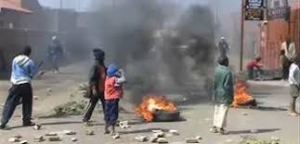
South Africa shacks residents protest for lack of servicesOur country is in a mess. Hunger, poverty, exploitation and injustice stalk the land.

The working class and poor face, at every step, the high walls of injustice, the chains of unemployment, and the bullets and batons of the police.

Conflicts shake the country, and hopes that shone in 1994 are fading, rusting under the waters of greed, oppression, and inequality; those hopes seem like a dream that fades when you awake to a grim reality.

Continue reading

Pre-Paid Electricity Meters or Power to the People?

by Pitso Mompe
(Tokologo African Anarchist Collective)

eskom-candleIn 2000 the South African government announced its policy was to provide “free basic services.” The free basic electricity  policy was released in 2003 and claimed that it would ensure that a “basic supply” of electricity is made available free of charge to poor households.

In practice, the amount provided in the “basic supply” is very limited, and soon runs out.

Continue reading

Stop Evictions, Stop the State, Defend the Working Class and Poor

By PITSO MOMPE
(Tokologo African Anarchist Collective)

B0856D149945CA9BB73B6286345D8BForced evictions are a violation of human rights that requires urgent global attention. In 2008 between 30 and 50 million people in 70 countries worldwide lived under constant threat of being forcibly evicted (according to the International Alliance of Inhabitants).

Those that are most affected are working class people and peasants living in poverty. It’s always the poor who are evicted.

Continue reading

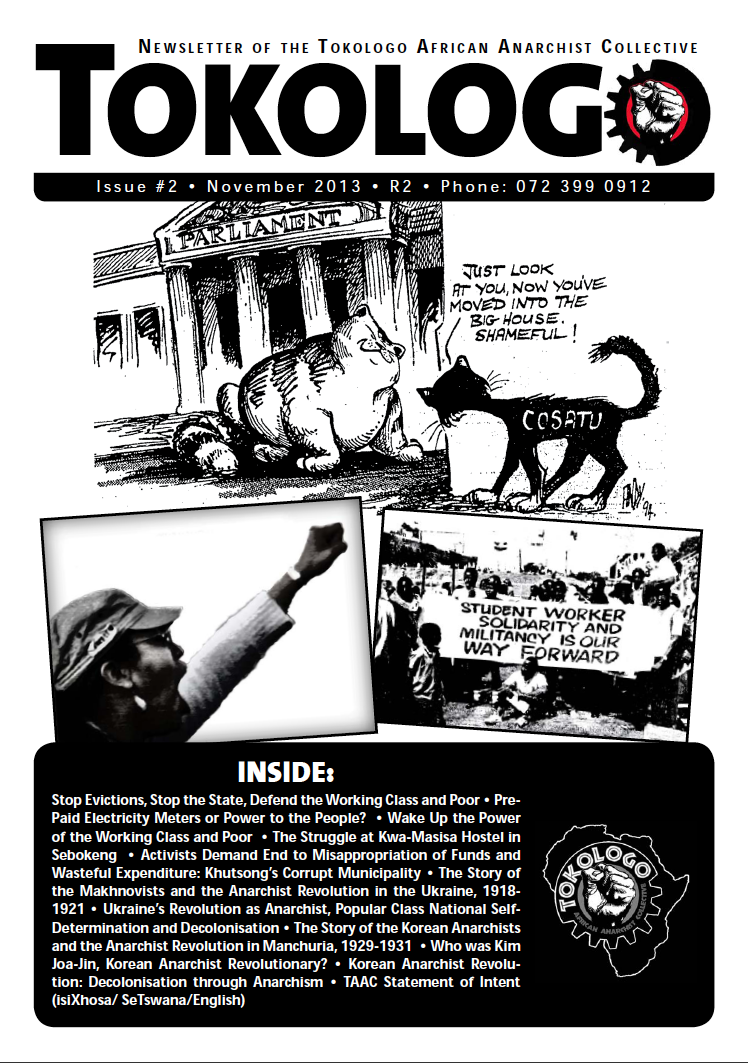
Download Issue #2 of the Newsletter of the Tokologo African Anarchist Collective

Tokologo 2

Download Issue #2 of the Newsletter of the
Tokologo African Anarchist Collective here

Editorial

Welcome to the second issue of Tokologo, produced by the Tokologo African Anarchist Collective.

Why do we publish this? We publish it because our country is crying out for an alternative. And that alternative is anarchism, which stands for a free and democratic society, run from the grassroots, in communities and workplaces, and based on equality and freedom. In such a society, wealth like land and factories would be collectively owned; production would be directed to meeting basic needs and ensuring environmental sustainability. In such a society, everyone would have a say in all matters that affect them; poverty and deprivation would be abolished; hatred and competition would be replaced by cooperation and mutual aid by all peoples.

Continue reading