Don’t Vote! Organise!

by Soundz of the South (SOS)

Voting copiapdf iconIn the build up to the 2014 elections, politicians – whether from the DA, ANC, EFF, or PAC – have been calling on us to vote. As part of this, they have promised to meet people’s needs, end poverty and serve communities when they are elected. The promises of all these politicians are lies.

Politicians don’t give a damn about workers and the poor; all they care about is their own power. They will tell us anything to get nice jobs in parliament. When politicians get into the state – whether at a municipal or national level – all they do is pass laws and put in place policies that benefit themselves and their rich friends. They protect their own interests and those of their allies in the form of the capitalists when they are in the state. Far from serving us; they wage a war on us. Continue reading

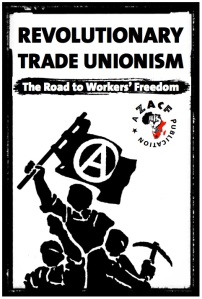
Revolutionary Trade Unionism: The Road to Workers’ Freedom

Click on image to download PDF leaflet

Click on image to download PDF leaflet

The trade unions are the combat organisations of the working class. They were built to defend and advance workers’ interests against the bosses.

BUT the unions can be MUCH more. The unions have the potential not only to fight the bosses in the here and now. They can ALSO organise the workers for a REVOLUTIONARY GENERAL STRIKE. This means that the workers take the land, mines and factories from the bosses and politicians. It means we run them in the interests of the workers and the poor.

Real democratic socialism and real working class freedom and power will never come through getting new political parties into parliament. This is an illusion. Parliament is the graveyard of struggles. It is the place where the radicals of yesterday become the crooked politicians of today.

Socialism, freedom and power can only come through class struggle. This means organising in communities AND building strong worker organisations.

Continue reading

The Crisis, Bailouts, Quantitative Easing, Tapering and Class War

The Crisis, Bailouts, Quantitative Easing, Tapering and Class Warby Shawn Hattingh

Since 2009 the US state has been undertaking Quantitative Easing (QE), which has involved the US state creating $ 85 billion a month, effectively electronically printing money out of thin air, and linking this to the “purchasing” of paper assets like US government bonds and also more importantly mortgaged backed securities from banks, hedge funds, private equity firms, and asset management companies, which lost their value when the capitalist crisis hit hard in 2008. Through this, these financial institutions and banks have been given up to $ 85 billion a month for the last five years. Much of this money has been used by these corporations to increase their speculative activity, including speculating on government bonds sold by the likes of the South African, Brazilian, Argentinean, and Turkish states. Now the US state has been looking to start tapering QE and speculators as a result are exiting these government bond markets. As this article explores it will probably not be the ruling class (capitalists and top state officials) that suffer the worst convulsions associated with tapering, although they may be affected, but the working class in countries such as South Africa, Brazil, Indonesia, India, Argentina and Turkey. This article examines why and how this could take place, how ruling classes from different countries are trying to protect themselves; and why and how the working class will in all likelihood be worst hit. In order to, however, understand how the class war around QE is unfolding it is important first to look at the role states have played during the crisis, along with the competition that exists between states.

Continue reading

What does the ZACF stand for?

ZACF logopdf iconZabalaza means struggle, the continual struggle of the working class to access real freedom. We mean freedom from the repression of the state, and oppression by multi-national as well as local companies. Too long has a small elite been in control. Workers and their communities have risen up many times in the past but have always been crushed by the police forces of the state. In the past the working class – including the poor and unemployed – has protested but often lost: social movements have burnt out and trade union leaders have made bad deals with the bosses.

Continue reading

Mandela, the ANC and the 1994 Breakthrough: Anarchist/Syndicalist Reflections on National Liberation and South Africa’s Transition

Nelson Mandelaby Shawn Hattingh and Lucien van der Walt
Since Nelson Mandela’s death, thousands of articles and millions of people have paid tribute to him. They have rightly praised him for his stance against the apartheid state, which saw him spend 27 years in prison, his non-racialism, and his contribution to the struggle in South Africa. For much of his life Nelson Mandela was indeed the most prominent figure in the liberation struggles in Africa that were waged in the 1960s, 1970s and 1980s.

Continue reading

Anarchism/Syndicalism as a Vision, Strategy and Experience of Bottom-up Socialist Democracy: A Reply to Daryl Glaser

Anarchism-Syndicalism-as-a-Vision-Strategy-and-Experienceby Lucien van der Walt

Politikon, 2013, Vol. 40, No. 2, 339 – 349

ABSTRACT Examining the theory and practice of ‘mass’ anarchism and syndicalism, this paper argues against Daryl Glaser’s views that workers’ council democracy fails basic democratic benchmarks and that, envisaged as a simple instrument of a revolution imagined in utopian ‘year zero’ terms, it will probably collapse or end in ‘Stalinist’ authoritarianism—Glaser also argues instead for parliaments, supplemented by participatory experiments. While agreeing with Glaser on the necessity of a ‘democratic minimum’ of pluralism, rights, and open-ended outcomes, I demonstrate, in contrast, that this ‘minimum’ is perfectly compatible with bottom-up council democracy and self- management, as envisaged in anarchist/syndicalist theory, and as implemented by anarchist revolutions in Manchuria, Spain and Ukraine. This approach seeks to maximise individual freedom through an egalitarian, democratic, participatory order, developed as both means and outcome of revolution; it consistently insists that attempts to ‘save’ revolutions by suspending freedoms, instead destroy both. Parliament, again in contrast to Glaser, from this perspective, meets no ‘democratic minimum’, being part of the state, a centralized, unaccountable institutional nexus essential to domination and exploitation by a ruling class of state managers and capitalists. Rather than participate in parliaments, ‘mass’ anarchism argues for popular class autonomy from, and struggle against, the existing order as a means of winning economic and political reforms while—avoiding ‘year zero’ thinking—also building the new society, within and against, the old, through a prefigurative project of revolutionary counter-power and counter-culture. Revolution here means the complete expansion of a bottom-up democracy, built through a class struggle for economic and social equality, and requiring the defeat of the ruling class, which is itself the outcome of widespread, free acceptance of anarchism, and of a pluralistic council democracy and self-management system.

Continue reading

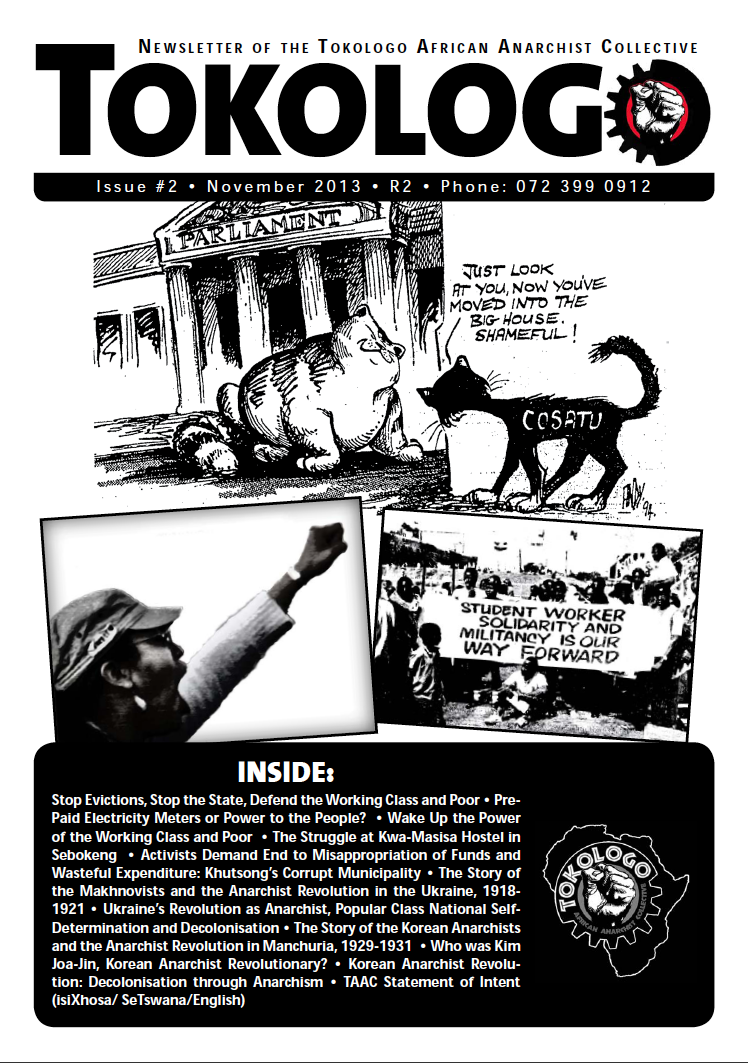
Download Issue #2 of the Newsletter of the Tokologo African Anarchist Collective

Tokologo 2

Download Issue #2 of the Newsletter of the
Tokologo African Anarchist Collective here

Editorial

Welcome to the second issue of Tokologo, produced by the Tokologo African Anarchist Collective.

Why do we publish this? We publish it because our country is crying out for an alternative. And that alternative is anarchism, which stands for a free and democratic society, run from the grassroots, in communities and workplaces, and based on equality and freedom. In such a society, wealth like land and factories would be collectively owned; production would be directed to meeting basic needs and ensuring environmental sustainability. In such a society, everyone would have a say in all matters that affect them; poverty and deprivation would be abolished; hatred and competition would be replaced by cooperation and mutual aid by all peoples.

Continue reading

Solidarity Against the Persecution of the Gaucha Anarchist Federation in Brazil

Federação Anarquista GaúchaCall for solidarity and endorsement against the persecution in Brazil of anarchist militants and the Federação Anarquista Gaúcha in Porto Alegre

In Porto Alegre, on June 20 last, about 15 officers from the Civil Police raided the Ateneo Batalha da Varzea, the political and social premises where the Federação Anarquista Gaúcha is located, without a warrant.

In this city where, since the beginning of the year, there have been massive demonstrations for popular demands concerning public transport, health, education, against corruption, with the aim of creating social change for their locality and their country.

Continue reading

ANC e latlhile seaparwelwa khemo so sone! Ba bolaile babereki!

Malema - desserts of capitalism [tswana]

Bathapi  le boradipolitiki ba molato!  Ba tshwanetse go
emisa mapodisi go dira dilo tse di sa siamang.

Ga gona molao, ga gona kagiso. Ga go na  Zuma,
ga go na  Malema, ga go na  LONMIN!

pdf iconA4 double-sided Flyer [seTswana]
Download here

Afrikaans | isiZulu | English

Molaotheo o tshepisitse ditokelo tsa dipolotiki le tekatekano. Go a bonagala gore boradipolotiki le bathapi ba dira ka mo ba ratang ka teng. Ba tshameka ka batho. Seo se bonagetse ka nako eo mapodisi a bolaileng badiri bao ba neng ba dirile ditshupetso kwa moepong wa Lonmin Marikana. Continue reading