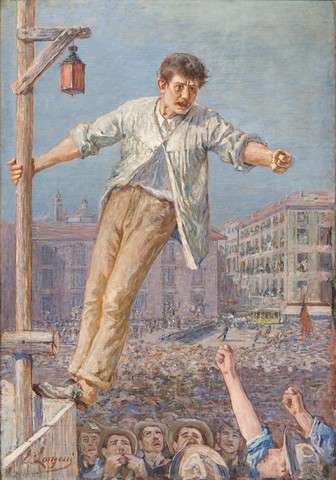
Anarchism/Syndicalism as a Vision, Strategy and Experience of Bottom-up Socialist Democracy: A Reply to Daryl Glaser

Anarchism-Syndicalism-as-a-Vision-Strategy-and-Experienceby Lucien van der Walt

Politikon, 2013, Vol. 40, No. 2, 339 – 349

ABSTRACT Examining the theory and practice of ‘mass’ anarchism and syndicalism, this paper argues against Daryl Glaser’s views that workers’ council democracy fails basic democratic benchmarks and that, envisaged as a simple instrument of a revolution imagined in utopian ‘year zero’ terms, it will probably collapse or end in ‘Stalinist’ authoritarianism—Glaser also argues instead for parliaments, supplemented by participatory experiments. While agreeing with Glaser on the necessity of a ‘democratic minimum’ of pluralism, rights, and open-ended outcomes, I demonstrate, in contrast, that this ‘minimum’ is perfectly compatible with bottom-up council democracy and self- management, as envisaged in anarchist/syndicalist theory, and as implemented by anarchist revolutions in Manchuria, Spain and Ukraine. This approach seeks to maximise individual freedom through an egalitarian, democratic, participatory order, developed as both means and outcome of revolution; it consistently insists that attempts to ‘save’ revolutions by suspending freedoms, instead destroy both. Parliament, again in contrast to Glaser, from this perspective, meets no ‘democratic minimum’, being part of the state, a centralized, unaccountable institutional nexus essential to domination and exploitation by a ruling class of state managers and capitalists. Rather than participate in parliaments, ‘mass’ anarchism argues for popular class autonomy from, and struggle against, the existing order as a means of winning economic and political reforms while—avoiding ‘year zero’ thinking—also building the new society, within and against, the old, through a prefigurative project of revolutionary counter-power and counter-culture. Revolution here means the complete expansion of a bottom-up democracy, built through a class struggle for economic and social equality, and requiring the defeat of the ruling class, which is itself the outcome of widespread, free acceptance of anarchism, and of a pluralistic council democracy and self-management system.
Continue reading

The Egyptian streets are stronger than the polling booths

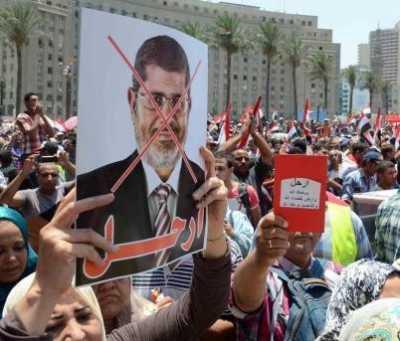
The Egyptian streets are stronger than the polling boothsTwo and a half years after the ousting of Hosni Mubarak, the Egyptian streets have spoken again. Mohamed Morsi has been ousted after a one-year reign and four days of demonstrations on an unprecedented scale in the history of the country. The Egyptians have reminded the world that an election is not a blank cheque which leaves representatives free from all constraint. Real democracy involves control over those mandated by those giving the mandate and it would be nothing without the ability to remove those who betray their mandate. No constitution gives that power to the workers (except for some “recall referendums”, à la Chavez) – the ruling classes would be too afraid of the democratic spiral that could eventually be damaging to them. Unconcerned with constitutions, the law, the supposed “democratic legitimacy” of elections, the workers in Egypt have reclaimed their destiny through collective and revolutionary mobilization. Let our little Western bosses beware, and let workers around the world take note!

Continue reading

Anarchism in Egypt — an interview from Tahrir Square

I met Mohammed Hassan Aazab earlier this year over tea at a table of young anarchists in downtown Cairo. The anniversary of the revolution had just passed with massive protests and the emergence of a Western-style black bloc that appeared to have little to do with anarchists in the city. At the time, much of the ongoing grassroots organizing was against sexual violence — in particular, the mob sexual assaults that have become synonymous with any large gathering in Tahrir. The trauma of such violence carried out against protesters was apparent in our conversation. In fact, Aazab told me that he was done with protests and politics, and had resigned himself to the dysfunction of day-to-day life in Egypt.

Then came June 30. Crowds reportedly as large as 33 million took to the streets to call for the Muslim Brotherhood to step down from power, just a year after Mohammed Morsi took office. In the pre-dawn moments of July 1, as Aazab’s phone battery dwindled steadily, I reconnected with him to chat a bit about his return to resistance.

An anarchist tent in Tahrir Square

An anarchist tent in Tahrir Square. (WNV/Mohammed Hassan Aazab)

Continue reading

Solidarity Against the Persecution of the Gaucha Anarchist Federation in Brazil

Federação Anarquista GaúchaCall for solidarity and endorsement against the persecution in Brazil of anarchist militants and the Federação Anarquista Gaúcha in Porto Alegre

In Porto Alegre, on June 20 last, about 15 officers from the Civil Police raided the Ateneo Batalha da Varzea, the political and social premises where the Federação Anarquista Gaúcha is located, without a warrant.

In this city where, since the beginning of the year, there have been massive demonstrations for popular demands concerning public transport, health, education, against corruption, with the aim of creating social change for their locality and their country.

Continue reading

Interview with Sam Mbah: Towards an Anarchist Spring in Nigeria

Sam Mbah

Sam Mbah

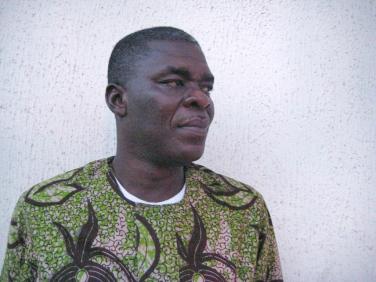
Sam Mbah is the co-author, with I. E. Igariwey, of African Anarchism, originally published in 1997. In that book, Mbah and Igariwey argued for an anarchist alternative in Africa. I have included excerpts from African Anarchism in Volume Three of Anarchism: A Documentary History of Libertarian Ideas. Last year, Mbah gave an interview in which he discusses the prospects for anarchism, and a “African Spring,” in Nigeria, where he remains active. Below, I reproduce some excerpts from the interview, in which Mbah discusses power and corruption in Nigeria, the negative role of established religion, the weakness of civil society and trade union organizations, the role of the oil industry, environmental degradation, deindustrialization and the need for continuing support from people outside of Nigeria.

The entire interview can be found at: http://sammbah.wordpress.com/

Continue reading

ANC e latlhile seaparwelwa khemo so sone! Ba bolaile babereki!

Malema - desserts of capitalism [tswana]

Bathapi  le boradipolitiki ba molato!  Ba tshwanetse go
emisa mapodisi go dira dilo tse di sa siamang.

Ga gona molao, ga gona kagiso. Ga go na  Zuma,
ga go na  Malema, ga go na  LONMIN!

pdf iconA4 double-sided Flyer [seTswana]
Download here

Afrikaans | isiZulu | English

Molaotheo o tshepisitse ditokelo tsa dipolotiki le tekatekano. Go a bonagala gore boradipolotiki le bathapi ba dira ka mo ba ratang ka teng. Ba tshameka ka batho. Seo se bonagetse ka nako eo mapodisi a bolaileng badiri bao ba neng ba dirile ditshupetso kwa moepong wa Lonmin Marikana. Continue reading

I-ANC ikhumula isifihla buso sayo! Kubulewe abasebenzi!

Malema - desserts of capitalism [zulu]Osozimali nosopolotiki banecala! Asimise ukuhlukunyezwa ngamaphoyisa. Akukho bulungiswa. Akukho xolo.

Asifuni uZuma, Asifuni uMalema, Asefuni iLONMIN!

pdf iconA4 double-sided Flyer [isiZulu]
Download here

AfrikaansEnglish | seTswana

Umthetho sisekelo walelizwe uthembisa amalungelo epolitiki nokulingana kwabantu. Kucacile ukuthi osozimali nosomapolitiki bazenzela umathanda. Banyathela ubuso babantu baseMzansi. Isibonelo esidumile esamaphoyisa ebulala abasebenzi bezimayini zaseLonmin Marikana. Continue reading

Tunisian Anarchists Condemn Upcoming WSF Meeting in Tunisia

Tunisian Anarchists Condemn Upcoming WSF Meeting in TunisiaCall World Social: The people want the fall of the system
Download the call here / pdf

Revolutionaries of the world,

On the occasion of the World Social Forum which will be held in Tunisia during March 2013, we believe that the liberal reformist approach opted for by the organizing bureaucracy of the Forum will in no way lead to a revolutionary project for the people of the world. Even though the event is presented as an opportunity for the revolutionaries coming from all corners of the globe to meet, we deem that the ultimate objective, namely the collapse of the capitalist system, will not be taken into consideration.

Continue reading

The Revolution, back in Black: The Black Bloc must provide Egyptians with a Positive Vision if they want their Struggle to Succeed

The Black Bloc in Egypt

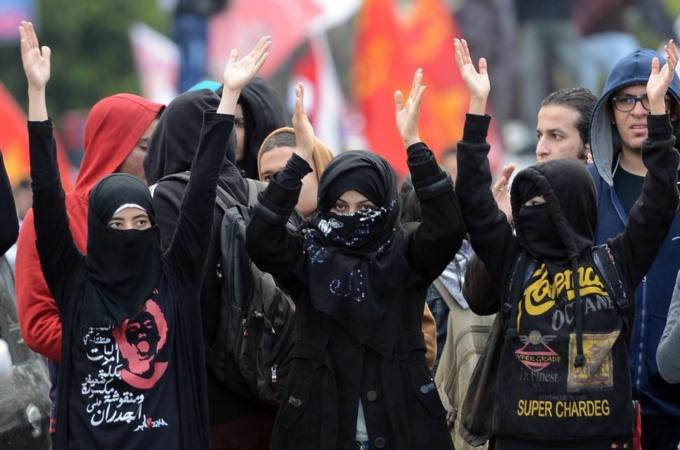
The black bloc in Egypt say they are the defenders of protesters opposed to President Mohamed Morsi’s rule [AFP]

The last time kids in black caused this much trouble in Egypt, it was Satan’s fault. Well, at least that’s what the Muslim Brotherhood and the Mubarak government claimed during the infamous “Satanic metal affair” of 1997, when over 100 metalheads – musicians and fans – were arrested and threatened with prosecution and even death simply because they dressed in black and liked extreme music.

The persecution of Egypt’s metalheads, or “metaliens” as many called themselves, drove the burgeoning scene underground for much of the next decade. It did not begin to resurface until the mid-2000s, at the same time as political movements like Kefaaya emerged, and the strikes in the industrial centre of Mahallah occurred. This period saw a renewed, if still sporadic, militancy that would coalesce into the revolutionary surge of late 2010 and early 2011.

Continue reading