All GEARed Up for a New Growth Path – on the Road to Nowhere [Zabalaza 13 vers.]

by Shawn Hattingh (ZACF)

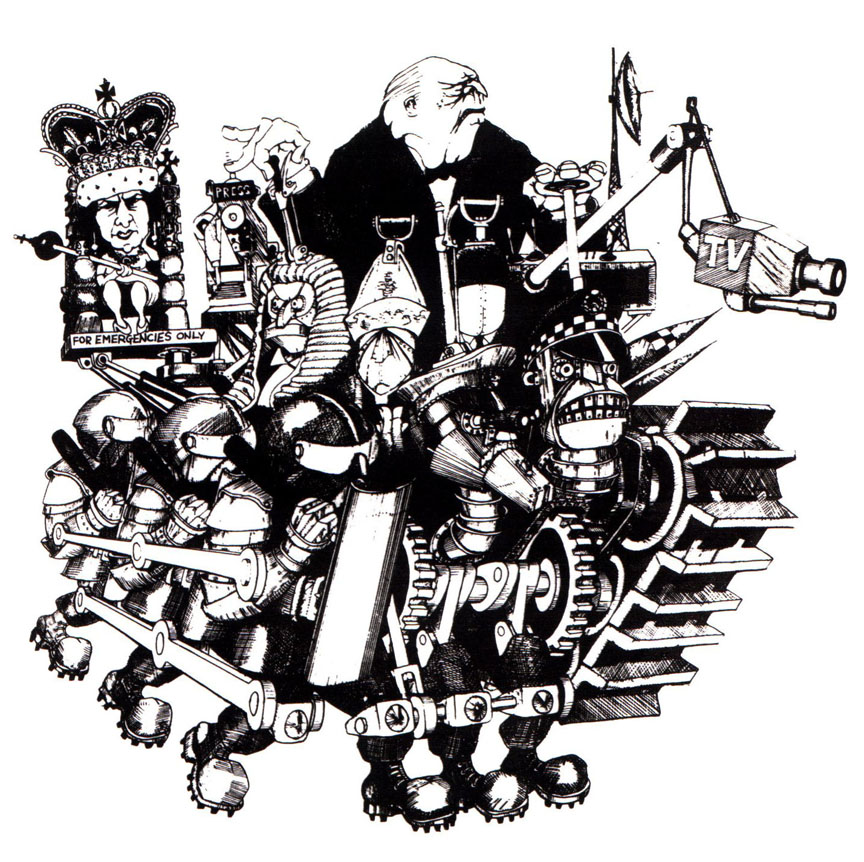
New Growth PathIt has become common knowledge that South Africa is the most unequal country in the world. Only 41% of people of working age are employed, while half of the people employed earn less than R 2 500 a month [1]. Worse still, inequality is growing with wages as a share of the national income dropping from 50% in 1994 to 45% in 2009; while profit as a share of national income has soared from 40% to 45% [2]. In real terms this means that while a minority live well – and have luxurious houses, swimming pools, businesses, investments, and cushy positions in the state – the majority of people live in shacks or tiny breezeblock dwellings, are surrounded by squalor, and struggle on a daily basis to acquire the basics of life like food and water. Likewise, while bosses, state managers, and politicians – both black and white – get to strut around in fancy suits barking orders; the majority of people are expected to bow down, do as told, and swallow their pride.

Continue reading

Whose State is it; and What is its Role? [Zabalaza 13 vers.]

by Shawn Hattingh (ZACF)

The StateThe South African state’s oppression of the ongoing wildcat strikes, including at Marikana, is clearly deepening. Over the last few weeks troops were deployed in the platinum belt in what was a barefaced bid by the state to stop the protests by striking workers, and essentially force them back to work. As part of this, residents at the informal settlement at Marikana, and those surrounding Amplats, have been subjected to a renewed assault by the police. Many residents in the process were shot with rubber bullets; their homes were raided; they were threatened; and tear gas, at times, lay over these settlements like a chemical fog. In practice, a curfew has also been put in place and anyone gathering in a group on the streets has been pounced upon by the men in blue. Threats have also emerged from the Cabinet that a crackdown on any ‘trouble-makers’, that are supposedly inciting workers to continue to strike, is going to happen. New arrests have also taken place at Marikana and even workers who are witnesses in the state’s Commission of Inquiry into the events at Lonmin have been arrested and harassed. A number of strikers at Amplats too have been killed or injured by the police.

Continue reading

Alternative Needed to Nationalisation and Privatisation: State Industries like South Africa’s ESKOM show Working Class deserves better

by Tina Sizovuka and Lucien van der Walt

“To assure the labourers that they will be able to establish socialism … [through] government machinery, changing only the persons who manage it… is… a colossal historical blunder which borders upon crime…”

Pyotr Kropotkin,
“Modern Science and Anarchism”

Introduction

Alternative Needed to Nationalisation and Privatisation: State Industries like South Africa’s ESKOM show Working Class deserves betterPrivatisation – the transfer of functions and industry to the private sector – is widely and correctly rejected on the left and in the working class. Privatisation leads only to higher prices, less and worse jobs, and worse services. Given this, some view nationalisation – the transfer of economic resources (e.g. mines, banks, and factories) to state ownership and control – as a rallying cry for a socialist alternative. As the supposedly pro-working class alternative, this cry has resounded in sections of the SA Communist Party (SACP), in the Congress of SA Trade Unions (Cosatu), in the African National Congress Youth League (ANCYL) membership, and on the independent Trotskyite and social democratic left.
This article argues that nationalisation has never removed capitalism, nor led to socialism, and it certainly does not have a demonstrable record of consistently improving wages, jobs, rights and safety. Nationalisation, rather than promote “workers’ control” or companies’ accountability to the public, has routinely meant top-down management, union-bashing, bad services and bad conditions.

Continue reading

Who Rules South Africa?: An Anarchist/Syndicalist Analysis of the ANC, the Post-Apartheid Elite Pact and the Political Implications

by Lucien van der Walt

Who Rules South Africa?2012 is the centenary of the African National Congress (ANC). The party that started out as a small coterie of black businessmen, lawyers and chiefs is today the dominant political formation in South Africa. It was founded by the black elite who were marginalised by the united South Africa formed in 1910, and who appeared at its Bloemfontein inauguration “formally dressed in suits, frock coats, top hats and carrying umbrellas”.[1] Today it is allied via the Tripartite Alliance to the SA Communist Party (SACP) and the Congress of South African Trade Unions (Cosatu).

Can the ANC be a vehicle for fundamental, progressive, social change in the interests of the black, Coloured and Indian working classes (proletariat), still mired in the legacy of apartheid and racial domination? This is what Cosatu (and the SACP) suggest.

Continue reading

Zabalaza #13 Editorial

Red and black greetings, comrades!

It’s been well over a year since the last issue of Zabalaza and much international attention has focused on the socio-economic problems facing the European Union. Despite the ravages of capitalism, and its neo-liberal form, the European ruling classes have responded, generally, with more of the same: increased attacks on the working class through propagating greater austerity measures, and less money spent on social welfare on the one hand, and bail-outs and more tax breaks for the rich on the other. As is to be expected, however, the European working class has not taken this lying down; resistance to austerity imposed from above has been widespread. In recent months we have witnessed, in Greece, a one-day general strike on October 18 and a 48-hour general strike on November 6 and 7.  Promisingly, and for the first time in the wake of the global economic crisis of 2008 – we have also witnessed a common European response in the form of a general strike on November 14 that affected Greece, Italy, Spain and Portugal, with solidarity actions occurring across much of the continent.

Continue reading

Zabalaza #13 (February 2013)

Zabalaza #13 Cover

Click image to download PDF

Contents:

Southern Africa:

Africa:

International:

Black Stars of Anarchism:

Book Review:

Theory:

Reaping What You Sow: Reflections on the Western Cape Farm Workers Strike

Western Cape Farm Workers Strike [image: 2oceansvibe.com]by Shawn Hattingh (ZACF)

The series of strikes and protests that recently took place in and around farms in South Africa’s Western Cape Province was fuelled by the deep-seated anger and frustration that workers feel. On a daily basis, farm workers face not only appalling wages, bad living conditions and precarious work, but also widespread racism, intimidation and humiliation. The extent of the oppressive conditions run deep and it is not uncommon for workers to even be beaten by farm-owners and managers for perceived ‘transgressions’. Indeed, life for workers in the rural areas has always been harsh, but over the last two decades it has in many ways gotten even worse and poverty has in many cases grown.

Continue reading

Freedom for the “1st of May Cooperative and Social Movement” Political Prisoners in Bariloche, Argentina

Freedom-for-the-1st-of-May-Cooperative-and-Social-Movement

“The looters are the politicians, who rob
the workers of their dignity”

The undersigned organisations support the February 5th international day of solidarity with the five political prisoners from the 1st of May Cooperative and Social Movement (M.S.C. 1º de Mayo) in Bariloche, Rio Negro (Argentina) – agreed to at the final plenary of the 10th annual Latin American Encounter of Popular Autonomous Organisations (ELAOPA) – and the call for their immediate release and return to their homes and families. We denounce the violent manner with which the gendarmeria, under order of the Federal Justice, dispersed the families of the political prisoners demonstrating in demand of their release on 21st January. Similarly, we stand firmly in solidarity with the Federation of Grassroots Organisations (FOB), which has suffered aggressions and accusations in certain media sources of being “looters and delinquents” for defending their rights and actively demonstrating their solidarity and support for the persecuted comrades of Bariloche.

Continue reading

Algeria: Repression of Unemployed Workers in Ouargla

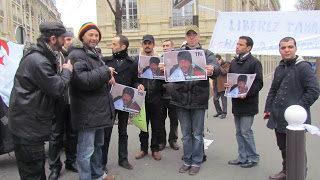
Demonstration in support of Tahar Belabes

On 2nd January last there were serious clashes during a demonstration organized by the National Committee for the Defense of the Rights of the Unemployed (CNDDC), part of the SNAPAP union. For an hour, right in the city centre, police used teargas and batons to disperse demonstrators, making several arrests. Beginning in the morning, hundreds of unemployed youths blocked the city centre of the town of Ouargla to protest against the poor management of employment in this oil town in the south of the country, Roads were closed to traffic and most shops and cafes closed. Demands included the dismissal of all local employment leaders ​​as well as the Labour Minister, Tayeb Louh, and the setting up by the government of a crisis office to start a dialogue with the unemployed workers. When protesters blocked the traffic, police forces were brutally launched against the protesters in order to restore circulation.

Continue reading

CSAAWU* Statement: 20 November

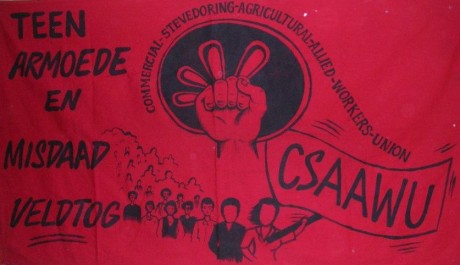
CSAAWU bannerFarmworkers Strikes Continue: Forward with Mass Mobilisation, Unity and Solidarity

For over 2 weeks now, farmworkers in different areas of the Western Cape have been striking. This is a spontaneous strike driven by workers on the ground in response to decades and decades of brutality at the hands of farmers and a government that has thus far refused to listen to workers and transform the rural landscape characterised by dependency master-slave relations, racism, sexism, starvation wages and violations of the limited freedoms won from decades of working class struggle. Farmworkers do backbreaking work sometimes for 12 hours a day to produce food and wine for everybody in this country and countries overseas yet they are forced to work under unsafe and unhealthy conditions, to drink dirty water, live without electricity, live without toilet facilities, on poverty wages, suffer threats of evictions, and violent physical and verbal abuse and intimidation at the hands of the bosses.

Continue reading