by Mandy Moussouris and Shawn Hattingh
Everything we are now is built upon all that we were and where we came from. The same can be said for countries, any analysis has to look backwards before it can begin to understand the influences and causes of the present. This makes analysis intrinsically complex and often, almost impossible. At some point we are forced to simplify, look for patterns and analyse situations with a focus on where the key locus of power lies.
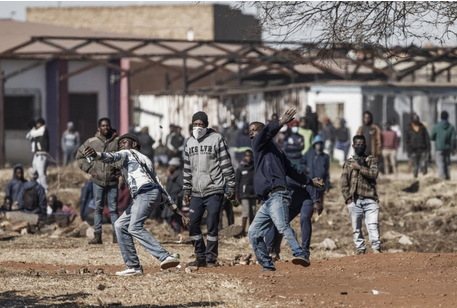
An analysis of the recent events taking place primarily in Kwa-Zulu Natal and Gauteng has to be done with this in mind. It is impossible to follow every strand of the complexity that is South Africa, but at the same time the link between the spate of large scale looting that took place and two very obvious conflicting ruling class power bases that currently exist in the country is undeniable. To claim that there was an exercising of working class power is to fundamentally misunderstand the powers at play and where the locus of power at this point in history actually lies.
 The question of state government elections and running a workers or socialist political party continues to be raised in the working-class movement and the Left globally. As we may know, there was excitement about the rise of Jeremy Corbyn in the Labour Party in Britain, about the successes of left political parties in certain parts of Europe and Latin America and, more recently, certain shifts to more centrist positions in the United States amongst a section of the Democratic Party calling themselves “Democratic Socialists.” In South Africa, many workers and some activists seem cautiously optimistic about NUMSA’s formation of the Socialist Revolutionary Workers Party that participated in the 2019 general elections, but did not manage to get a seat in Parliament.
 Ghana, West Africa, was a British colony called “Gold Coast” until 1957. It became the first independent country in “black” Africa after reforms and struggles in the 1940s and 1950s. The new president, the brilliant Kwame Nkrumah, and his Convention People’s Party (CPP), had fought for independence. Now they aimed at major changes in the society, even speaking of socialism. And Nkrumah proposed a united African government for the continent: Pan-Africanism.
 zabalaza.net