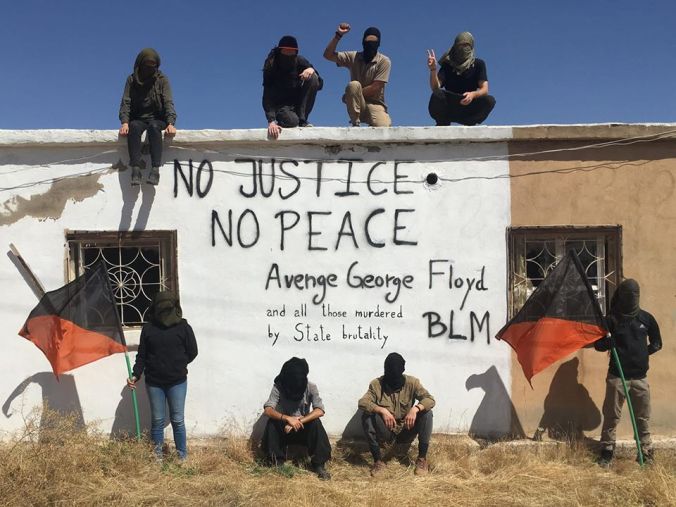
Anarchists in Rojava, Northern Syria, standing in solidarity with Black Lives Matter and anti-colonial struggles.
Hundreds of thousands of protesters have taken to the streets across the United States and beyond in response to the police killing of George Floyd. Protesters in Minneapolis, New York, Los Angeles and dozens of other cities demanding justice were met with extreme police violence, leading to more deaths and numerous injuries.
A common slogan heard at the protests is “No justice, no peace!,” raising the essential question of how a political system founded on a bloody history of white supremacy, capitalism and colonialism can ever provide true and meaningful justice. Some call for police reforms. Others call for the redistribution of funds. Still others argue that abolishing the police is the best option, but many people — even on the left — find it hard to imagine the viability of such a system.
Democratic confederalism, the ideological framework organizing society in Rojava, outlines the features of a post-revolutionary justice system.
 Before there was the Congress of South African Trade Unions, today’s COSATU, there was FOSATU. FOSATU was set up in 1979. There had been strikes and struggles in the 1970s, starting with a big strike wave in Namibia from 1971-1972, which was then a South African colony, then a big strike wave starting in Durban 1973, which spread around the country. Although we remember 1976 for the bravery of the youth and students, we must remember that the 1976 uprising also involved general strikes by the black working class, mass stay-aways.
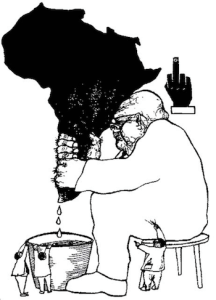 Roughly 50 years ago we saw the dismantling of most of the European colonial empires in Africa. High hopes greeted the “new nations” that merged – and certainly, a move from colonial rule, with its racism and external control and extractive economies, was progressive.
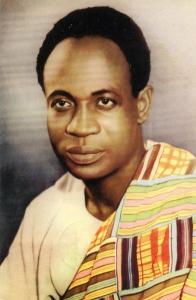 Ghana, West Africa, was a British colony called “Gold Coast” until 1957. It became the first independent country in “black” Africa after reforms and struggles in the 1940s and 1950s. The new president, the brilliant Kwame Nkrumah, and his Convention People’s Party (CPP), had fought for independence. Now they aimed at major changes in the society, even speaking of socialism. And Nkrumah proposed a united African government for the continent: Pan-Africanism.

 zabalaza.net