 In examining the possibilities for politics within and at a distance from the state, it is important to revisit the democratic traditions of the working class, which are often learned through struggles and strikes – and which were exemplified by the new unions of the 1970s and 1980s. Not much of this alternative tradition of democracy outside the state has been captured in official histories, which present the attainment of democracy in terms of the formation of a parliamentary government in 1994.
There is a larger problem here of how the working-class heritage – the intellectual and organisational and political traditions of labour and the left – has been side-lined in media, textbooks, monuments and narratives; this also involves a narrowing of our political imagination, with our view of “democracy” itself narrowed dramatically. There has been a focus on elections and political parties and electoral politics. This reflects and reinforces a view that assumes a separation of the political – basically left to the state and the parties – and the economic – issues like wage negotiations are left to unions, and union involvement in politics is increasingly reduced to lobbying political parties.
Download PDF here
 Centred on the Congress of South African Trade Unions (COSATU), and within it, key unions like the National Union of Metalworkers of South Africa (NUMSA), the unions developed an ideological and strategic orientation described by scholars (e.g. Eddie Webster and Glenn Adler, 2000) as “radical reform” or “structural reform.” The thinking of the main unions in South Africa remains, to this day, profoundly shaped by the “radical reform” (RR) model.
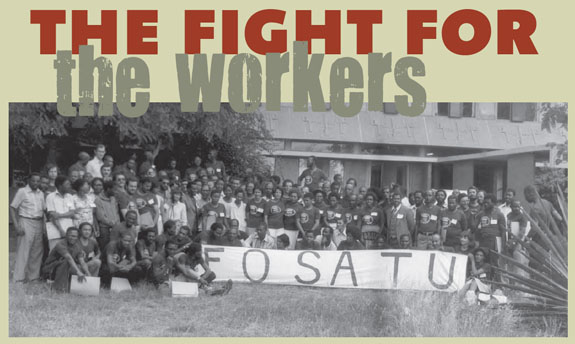
 Before there was the Congress of South African Trade Unions, today’s COSATU, there was FOSATU. FOSATU was set up in 1979. There had been strikes and struggles in the 1970s, starting with a big strike wave in Namibia from 1971-1972, which was then a South African colony, then a big strike wave starting in Durban 1973, which spread around the country. Although we remember 1976 for the bravery of the youth and students, we must remember that the 1976 uprising also involved general strikes by the black working class, mass stay-aways.

 zabalaza.net