Towards a History of Anarchist Anti-Imperialism

“In this struggle, only the workers and peasants will go all the way to the end”

The anarchist movement has a long tradition of fighting imperialism. This reaches back into the 1860s, and continues to the present day. From Cuba, to Egypt, to Ireland, to Macedonia, to Korea, to Algeria and Morocco, the anarchist movement has paid in blood for its opposition to imperial domination and control.

However, whilst anarchists have actively participated in national liberation struggles, they have argued that the destruction of national oppression and imperialism can only be truly achieved through the destruction of both capitalism and the state system, and the creation of an international anarcho-communist society.

This is not to argue that anarchists absent themselves from national liberation struggles that do not have such goals. Instead, anarchists stand in solidarity with struggles against imperialism on principle, but seek to reshape national liberation movements into social liberation movements.

Such movements would be both anti-capitalist and anti-imperialist, would be based on internationalism rather than narrow chauvinism, would link struggles in the imperial centres directly to struggles in the oppressed regions, and would be controlled by, and reflect the interests of, the working class and peasantry.

In other words, we stand in solidarity with anti-imperialist movements, but condemn those who use such movements to advance reactionary cultural agendas (for example, those who oppose women’s rights in the name of culture) and fight against attempts by local capitalists and the middle class to hijack these movements. We oppose state repression of anti-imperialist movements, as we reject the right of the state to decide what is, and what is not, legitimate protest. However, it is no liberation if all that changes is the colour or the language of the capitalist class.
Continue reading

Revolutionary Anarchism and the Anti-Globalisation Movement

[This article in Italian]

Riot police battling youth. Armed forces locking down a major American city. Tens of thousands under anti-capitalist banners. Western youth and workers physically battling the WTO and imperialism. These potent images of the ‘battle of Seattle’, November 30, 1999, were seared into the minds of militants the world over, inspiring millions upon millions fighting against the class war from above that some call ‘globalisation’. Followed by further mass protests in Washington and Davos, and two massive international co-ordinated actions on May 1, 2000 and September 26, 2000, Seattle marked, by any measure, an important turning point for the global working class and peasantry.

“The Idea That Refuses To Die”

And anarchists were in the thick of these protests and solidarity actions, whether in Rio, Johannesburg, Prague, Istanbul, New York or Dublin, demonstrating an impressive organizational ability, growing credibility, and rising popular appeal.

Continue reading

Race, Class and Organisation

The View from the Workers Solidarity Federation *

Originally published in Black Flag, 1998

INTRODUCTION BY BLACK FLAG:

We recently observed a very fruitful discussion on race and class on the internet, particularly around “black” anarchism, special oppressions and the desirability of separate organisation.

One of the best and most comprehensive posts came from a member of the Workers Solidarity Federation of South Africa, an anarchist/syndicalist group which while in a personal capacity reflects their politics and positions on these matters. Interest in anarchism is growing throughout the world. There are active groups in most parts of the world, with the exception of the Indian subcontinent, Antarctica and as far as we know the Chinese dictatorship. This process will no doubt accelerate and there is a challenge for us to make our ideas accessible. But as our South African comrades point out below, “it was the ability of anarchism to provide alternatives and to pay special attention to the specific needs of these different sections of the working class in order to unite the whole class that made the success (of the Cuban anarchists and IWW) possible,” not “a revision of anarchism to accommodate nationalism”.

Continue reading

Class Struggle without Borders: The Recolonisation of Africa and the Future of the Left

Talk given by comrade MS of the WSF * at the University of Zambia, Lusaka, Zambia, August 1998

I would like to thank the Socialist Caucus for extending an invitation to a speaker from the Workers Solidarity Federation (WSF) in South Africa. I would also like to thank the University of Zambia for hosting me this evening.

I am a member of the Workers Solidarity Federation. Let me start by saying what the WSF is not. We are not a political party that runs in elections. Nor are we a trade union. We are a libertarian socialist (anarcho-syndicalist) political organization. We believe that socialism must come from below through the direct action of workers and peasants. We support all forms of struggle against privilege and oppression. However our main focus is on the trade unions, which we see as a crucial mechanism for bringing about radical – and necessary – social change. Our membership base is predominantly amongst Black students and Black workers.

Continue reading

Anarchism, Racism and the Class Struggle

Racial oppression remains a defining feature of the modern capitalist world. It is manifest most spectacularly in violent attacks on immigrants and minorities by fascist gangs. More important to the fate of these communities has been the systematic and increasing discrimination by capitalist states, manifest in attacks on the rights of immigrants, cuts in welfare services, and racist police and court systems.

How can racism be defeated?

An answer to this question requires an examination of the forces which gave rise to, and continue to reproduce, racism. It also requires a careful analysis of which social forces benefit from racial oppression.

By racism is meant either an attitude denying the equality of all human beings, or economic, political and social discrimination against racial groups.

Continue reading

South Africa after Apartheid

Article in Le Mode Libertaire by WSF * delegate to the October/November 1997 congress of the International of Anarchist Federations, Lyon, France.

Historically, South Africa epitomized the poverty and oppression associated with capitalism and racism. The first non-racial elections to parliament in April 1994 gave many hope for the redress of the injustices of the past. The holding of elections open to all people, and the replacement of racist laws by basic democratic and civil rights was a big victory for the struggle in South Africa. But the new government of Nelson Mandela and the African National Congress (ANC) has consistently failed to address the demands of the Black working class for equality and the redistribution of wealth

INEQUALITY

In South Africa, 47% of Black African households live on, or below, the poverty line. Yet the ten richest South African families are together worth R18 billion. In South Africa there is an unemployment rate of 30%, but managers in big companies earn up to R900,000 per year. 5 big companies control 801@,@ of the Johannesburg Stock Exchange, and 120,000 (mainly White) farmers own 87% of the land.

Continue reading

Anarchism and the ‘New’ South Africa

An Interview with the South African WSF *

Q. Most readers of Red and Black Revolution will be familiar with the main organisations on the left in South Africa, such as the ANC and the South African Communist Party (SACP). Can you tell us something about the tradition of libertarian ideas and struggle?

A. Anarchism and Syndicalism do (or at least did) have an important place in South African history, although this is typically hidden or obscured by official and “radical” versions of the past. Before the founding of the SACP in 1921, libertarian ideas were common on the revolutionary left. A section of the US syndicalist union, the Industrial Workers of the World, was established here in 1911, growing out of an organisation called the Industrial Workers Union . The Industrial Workers Union, in turn, was set up by the conservative craft-dominated (and, one must add, racist) Witwatersrand Trades and Labour Council (WTLC) at the behest of Tom Mann, the British revolutionary, who visited South Africa in 1910. The IWW (SA) was aligned to the Chicago (anti-parliamentary section) of the IWW (US), and the Voice of Labour – a radical local paper with which it was closely associated – carried articles by American anarchist-syndicalists like Vincent St. John. The IWW (SA) mainly organised amongst unskilled poor Whites (and also among groups like the bookmakers). They launched several strikes but collapsed in or about 1913. Some syndicalists were also active within the WTLC, although it must be stressed that they opposed that organisation’s racist politics – for example, they organised amongst Black miners as well as White.

Continue reading

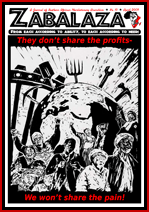
Zabalaza #10 (April 2009)

Zabalaza #10 cover

Click above to download the PDF

Contents:

Southern Africa

  • Editorial by Zabalaza Anarchist Communist Front (ZACF)
  • Unite Against the Minority, Then Unite Against the Majority? (Zambia) by Malele D. Phirii, Zambia
  • The Jacob Zuma Cargo Cult and the “Implosion” of Alliance Politics (South Africa) by Michael Schmidt (ZACF)
  • A Bitter Taste to the Sugarcane (Swaziland)
    by Michael Schmidt (ZACF)
  • Four Tools for Community Control – Part I: “Mutual Aid” (Southern Africa) by Steffi (ZACF)
  • Zimbabwe’s Party-Political Stitch-Up – How the Zanu-PF/MDC Deal Ignored Civil Society by Jonathan P. (ZACF)

Africa

  • The Anarchist Movement in North Africa: 1877 – 1951 by Michael Schmidt (ZACF) & Lucien van der Walt
  • Socialists and Gaullists Haunted by the Ghosts of Genocide (Rwanda) by Guillaume Davranche (Alternative Libertaire), France

International

  • Jalan Journal: A New Asian Anarchist Voice is Born with introduction by Michael Schmidt (ZACF)
  • 30th Congress of the National Confederation of Labour (France) by CNT-F
  • Hamas, the Left and Liberation in Palestine by Sevinc (Workers’ Solidarity Movement), Ireland
  • Interview with Ilan Shalif from Anarchists Against the Wall – Israel/Palestine
  • A Hot Winter in Greece by Steffi (ZACF)
  • Something Smells Different in Cuba by Movimiento Libertario Cubano, with introduction by Michael Schmidt (ZACF)
  • Imperialism, China and Russia by Pier Francesco Zarcone (Federazione dei Comunisti Anarchici), Italy
  • Against Political Terror in Russia, We Mobilise! by the Internatioal Secretary, Alternative Libertaire, France/ Belgium
  • Change We Need: An Anarchist Perspective on the 2008 US Election by North-Eastern Federation of Anarchist Communists (NEFAC), USA, with introduction by Michael Schmidt (ZACF)

Theory

  • Tangled Threads of Revolution: Reflections on Anarchist Communists: A Question of Class by James Pendlebury (ZACF)

Continue reading

Fighting for Women’s Freedom [ZACF]

Why do you women allow people to mistreat you? Because you depend on others to eat… Why don’t you have food to eat? Because the rich have stolen our property and walk over the majority of the people…

What is [the] solution? Practising Anarchism…  All women know that there is nothing more evil than money.

Everyone, become of one mind! Unite with men and completely overthrow the upper classes and the rich! Then money will be abolished…  At this time, not only will eating not require reliance on others, but the food that will be eaten will be good food, too.

He Zhen, Chinese woman Anarchist
“What Women Ought to Know about Anarchist Comunism”

[Download PDF]

Continue reading

Trade Unions and Revolution [ZACF]

“It is necessary to never forget that if trade unionism does not find in libertarian communist theory a support in opportune times it will turn, whether we like it or not, to the ideology of a political statist party”.

Nestor Makhno, Peter Archinov, Ida Mett et al,
The Organisational Platform of the Libertarian Communists

“…according to the Syndicalist view, the trade union, the syndicate, is the unified organisation of labour and has for its purpose the defence of the interests of the producers in the existing society and the preparing for and the practical carrying out of the reconstruction of social life after the pattern of [libertarian] Socialism. It has, therefore, a double purpose…”

Rudolph Rocker,
Anarcho-syndicalism

[Download PDF]

Continue reading