by Shawn Hattingh (ZACF)
 Introduction
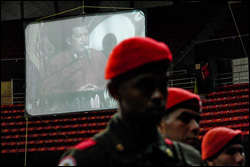
For many people on the left, within and outside of Southern Africa, the ‘Bolivarian Revolution’ is seen as a beacon of socialist hope in a sea of capitalist despair [1]. The reason why many leftists feel so strongly attached to this project, and promote it as an alternative, is because they have come to view it as a move by the Venezuelan state towards creating a genuine, free form of socialism [2] or at the very least an experiment that profoundly breaks with the tenets of neo-liberalism [3] [4]. Many articles have, therefore, been written lauding the state’s nationalisation of some industries [5], its land distribution programmes [6], and its attempts to supposedly create participatory democracy in workplaces (through co-management and co-operatives) [7] and in communities (through community councils) [8]. Linked to this, a great deal has also been made of the state using some of revenue generated by the Petróleos de Venezuela (PDVSA) to roll out social services such as education, subsidised foodstuffs and healthcare [9]. Much ink has, consequently, been spilt arguing that all of these are socialist inspired moves and passionate calls have been made for other states, like the South African state, to adopt Venezuelan style ‘Socialism for the Twenty First Century’ [10].

 Once again much media fanfare has broken out in aftermath of the South African state’s budget speech. The budget, however, is yet more proof of the ANC’s ruling class agenda: free markets, budget cuts for the poor and subsidies for the rich. From the budget and other utterances it is clear the ANC has, despite media hysteria, no interest in nationalisation. The state will, therefore, try and deal with the global economic crisis largely through business-as-usual.




 zabalaza.net