Mandela, the ANC and the 1994 Breakthrough: Anarchist/Syndicalist Reflections on National Liberation and South Africa’s Transition

Nelson Mandelaby Shawn Hattingh and Lucien van der Walt

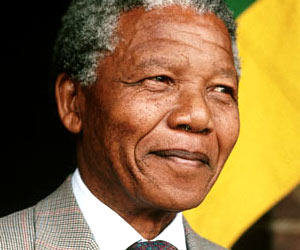
Since Nelson Mandela’s death, thousands of articles and millions of people have paid tribute to him. They have rightly praised him for his stance against the apartheid state, which saw him spend 27 years in prison, his non-racialism, and his contribution to the struggle in South Africa. For much of his life Nelson Mandela was indeed the most prominent figure in the liberation struggles in Africa that were waged in the 1960s, 1970s and 1980s.

Continue reading

Anarchism/Syndicalism as a Vision, Strategy and Experience of Bottom-up Socialist Democracy: A Reply to Daryl Glaser

Anarchism-Syndicalism-as-a-Vision-Strategy-and-Experienceby Lucien van der Walt

Politikon, 2013, Vol. 40, No. 2, 339 – 349

ABSTRACT Examining the theory and practice of ‘mass’ anarchism and syndicalism, this paper argues against Daryl Glaser’s views that workers’ council democracy fails basic democratic benchmarks and that, envisaged as a simple instrument of a revolution imagined in utopian ‘year zero’ terms, it will probably collapse or end in ‘Stalinist’ authoritarianism—Glaser also argues instead for parliaments, supplemented by participatory experiments. While agreeing with Glaser on the necessity of a ‘democratic minimum’ of pluralism, rights, and open-ended outcomes, I demonstrate, in contrast, that this ‘minimum’ is perfectly compatible with bottom-up council democracy and self- management, as envisaged in anarchist/syndicalist theory, and as implemented by anarchist revolutions in Manchuria, Spain and Ukraine. This approach seeks to maximise individual freedom through an egalitarian, democratic, participatory order, developed as both means and outcome of revolution; it consistently insists that attempts to ‘save’ revolutions by suspending freedoms, instead destroy both. Parliament, again in contrast to Glaser, from this perspective, meets no ‘democratic minimum’, being part of the state, a centralized, unaccountable institutional nexus essential to domination and exploitation by a ruling class of state managers and capitalists. Rather than participate in parliaments, ‘mass’ anarchism argues for popular class autonomy from, and struggle against, the existing order as a means of winning economic and political reforms while—avoiding ‘year zero’ thinking—also building the new society, within and against, the old, through a prefigurative project of revolutionary counter-power and counter-culture. Revolution here means the complete expansion of a bottom-up democracy, built through a class struggle for economic and social equality, and requiring the defeat of the ruling class, which is itself the outcome of widespread, free acceptance of anarchism, and of a pluralistic council democracy and self-management system.

Continue reading

Wake Up the Power of the Working Class and Poor

by Lucien van der Walt
(Tokologo African Anarchist Collective)

South Africa shacks residents protest for lack of servicesOur country is in a mess. Hunger, poverty, exploitation and injustice stalk the land.

The working class and poor face, at every step, the high walls of injustice, the chains of unemployment, and the bullets and batons of the police.

Conflicts shake the country, and hopes that shone in 1994 are fading, rusting under the waters of greed, oppression, and inequality; those hopes seem like a dream that fades when you awake to a grim reality.

Continue reading

Pre-Paid Electricity Meters or Power to the People?

by Pitso Mompe
(Tokologo African Anarchist Collective)

eskom-candleIn 2000 the South African government announced its policy was to provide “free basic services.” The free basic electricity  policy was released in 2003 and claimed that it would ensure that a “basic supply” of electricity is made available free of charge to poor households.

In practice, the amount provided in the “basic supply” is very limited, and soon runs out.

Continue reading

An Egyptian anarchist on the current uprising

an interview by Mark Mason
ASR (Anarcho-syndicalist Review),no. 60, 2013

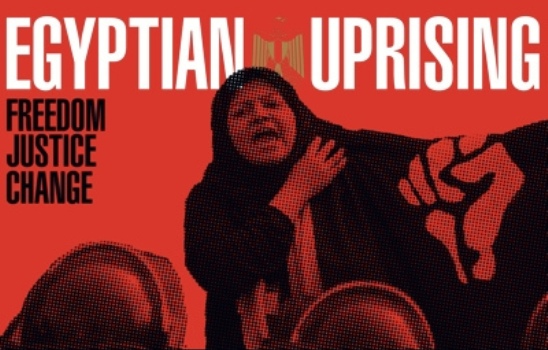
egypt-uprisingOn July 3, 2013, President Mohammed Morsi of Egypt was  removed from office, having been pushed out by the largest popular  uprising in modern history. Tens of millions of Egyptians were in  the streets marching throughout the country. To explore the fac tors contributing to the overthrow of Egypt’s first democratically  elected president, I interviewed M. Saad, a long-time Egyptian  activist, for ASR.

Continue reading

Stop Evictions, Stop the State, Defend the Working Class and Poor

By PITSO MOMPE
(Tokologo African Anarchist Collective)

B0856D149945CA9BB73B6286345D8BForced evictions are a violation of human rights that requires urgent global attention. In 2008 between 30 and 50 million people in 70 countries worldwide lived under constant threat of being forcibly evicted (according to the International Alliance of Inhabitants).

Those that are most affected are working class people and peasants living in poverty. It’s always the poor who are evicted.

Continue reading

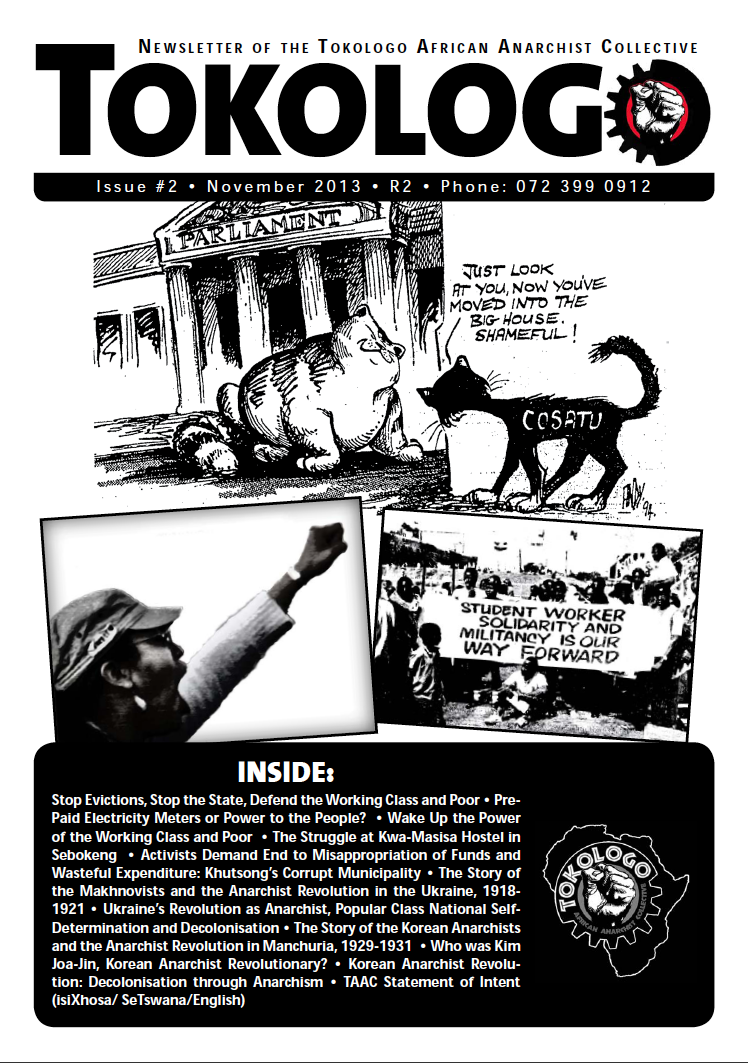
Download Issue #2 of the Newsletter of the Tokologo African Anarchist Collective

Tokologo 2

Download Issue #2 of the Newsletter of the
Tokologo African Anarchist Collective here

Editorial

Welcome to the second issue of Tokologo, produced by the Tokologo African Anarchist Collective.

Why do we publish this? We publish it because our country is crying out for an alternative. And that alternative is anarchism, which stands for a free and democratic society, run from the grassroots, in communities and workplaces, and based on equality and freedom. In such a society, wealth like land and factories would be collectively owned; production would be directed to meeting basic needs and ensuring environmental sustainability. In such a society, everyone would have a say in all matters that affect them; poverty and deprivation would be abolished; hatred and competition would be replaced by cooperation and mutual aid by all peoples.

Continue reading

Eskom’s tariff hikes cannot be avoided

By Nthabiseng Motahane
(Tokologo African Anarchist Collective)

eskom-stranglesWe, the people of South Africa, are suffering from the tariffs of Eskom. Electricity prices  are increasing every three years. This process is called a “multiple year pricing determination.” Eskom started borrowing money from the World Bank and others as a loan. We, the poor and working class, are the ones who are going to pay the interest through the rising prices. In 1994  we thought that we had access to everything in South Africa – housing, electricity, service delivery, health care – but that was wishful thinking.

Continue reading