 General al-Sisi, a former army chief (and now Egyptian leader – Organise! editors) must grapple with the country’s economic problems as with infighting in the circles of power. —- Abdel Fattah al-Sisi seems to be a victim of his own success. He who in July 2014, seemed to hold a “supernatural” power and popularity supported by a ferocious media machine devouring everything in its path, is now trapped in his post as the strongest man in Egypt. It is even ironic to see him drown in the same defects as those that toppled the President that he overthrew: An empty and populist discourse, measures to capture executive and legal authority in Egypt (while having put Adli Mansour as malleable puppet at the head of the state), etc. Likewise, the socio-economic problems on which he relied to bring down the government of the Muslim Brotherhood have not been solved: power cuts are back at the same rate as at the time of the Muslim Brotherhood, the geopolitical crisis from the construction of the Annahda (Renaissance) dam on the Nile by Ethiopia is nowhere near being solved, (which could have disastrous effects on Egyptian agriculture-Organise! editors) the prices of staple goods are rising, not to mention the crisis in the important area of the economy which is tourism.
Obituary of Nigerian anarchist Sam Mbah
 Zabalaza Anarchist Communist Front is deeply saddened to hear of the death a great human being, African brother, and fellow activist – Sam Mbah. We would like to send our deepest sympathies to those who knew Sam. We hope that you are comforted by the fact that the time he did spend with us was put to its absolute fullest use.
It is particularly difficult for us in South Africa to hear of this news because we are likewise struggling to build a movement that, as Sam has always acknowledged, is still in its infancy and will take some time to “crystallize”. Knowing that people like Sam were out there in other parts of Africa doing what we are trying to do here was a great inspiration to us. It helped us to continue on a long and difficult path. Sam’s individual contribution to our own (and collective) project of building a strong and viable anarchist movement in Africa was massive, and his departure will be sorely felt. But we feel comforted in the fact that his legacy will be an inspiration for others who will eventually follow in his footsteps.
Tokologo #4 poster

“I am truly free only when all human beings, men and women, are equally free. The freedom of other men, far from negating or limiting my freedom, is, on the contrary, its necessary premise and confirmation”. MIKHAIL BAKUNIN
Build a Strong People: Latin American Lessons in Leadership
 by Jonathan Payn (ZACF)
As working class activists, we should share experiences with – and learn from – working class struggles in other places. The ruling class organises worldwide to exploit and dominate our class. So we need to organise resistance to defend our interests everywhere. And we can only benefit from arming ourselves with lessons from different working class movements.
An important example of working class resistance from which we, in South Africa, can draw inspiration is the Brazilian Resistência Popular (Popular Resistance). This organises with unions, student and neighbourhood movements, and it promotes mobilisation and organisation based on grassroots democracy, direct struggle, and solidarity across the broad working class. It exists in various cities, and stresses the importance of people organising themselves, from the bottom up, outside of the parliamentary system, and against the economic and political elites.
Bernard Sigamoney, Durban Indian revolutionary syndicalist
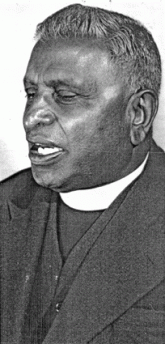
by Lucien van der Walt
A global movement, the anarchist and syndicalist tradition has influenced people from all walks of life. A notable figure was Bernard L.E. Sigamoney, born in 1888. The grandson of indentured Indian labourers, who arrived in South Africa in the 1870s, he became a school teacher with a working class outlook.
A hundred years ago saw the First World War (1914-1918) sear the globe: almost 40 million died. South Africa, as part of the British Empire, sent troops and workers to battles in Africa and Europe.
Our History of Struggle: the 1980s “Workerist-Populist” Debate Revisited
 Compiled by WARREN MCGREGOR (TAAC, ZACF)
Workshop contributors: Lucky, Pitso, Bongani, Siyabulela,
Nonzukiso, Nonzwakazi, Mzwandile
EDITOR’S INTRODUCTION: Today the terms “populism” and “workerism” are widely thrown about in South African political circles. Often, these terms and others (“syndicalism,” “ultra-left,” “counter-revolutionary,” “anti-majoritarian” …) have no meaning: they are just labels used to silence critics. SA Communist Party (SACP) leaders do this often. But in the 1980s, “populism” and “workerism” referred to two rival positions battling for the soul of the militant unions.
These debates, thirty years on, remain very relevant: let us revisit them, and learn. Today’s radical National Union of Metalworkers of SA (NUMSA) was part of the “workerist” camp, while its key rival, the National Union of Mineworkers (NUM) was identified with “populism.” The early battles over the direction of the Congress of SA Trade Unions (COSATU) still echo today, although there is no longer a clear “workerist” camp.
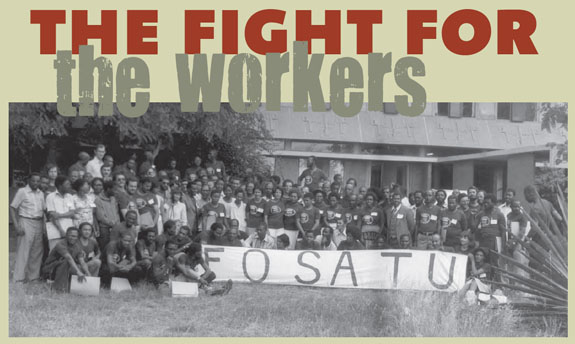
FOSATU was launched on 14 and 15 April 1979 at Hammanskraap. Workers’ democracy and control were the core tenets upon which FOSATU was founded.
The 1976 Struggle and the Emancipation of the Future: Developing Self-determined and Self-motivated Youth despite Looming Fate
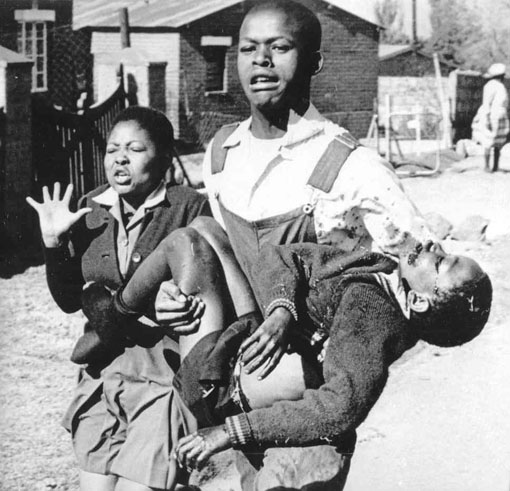
Hector Pieterson (1964 – June 16, 1976). Killed at age 12 when the police opened fire on protesting students. 16 June stands as a symbol of resistance to the brutality of the apartheid government.
by Bongani Maponyane (TAAC, ZACF)
The massacre of South African school children in 1976 continues to be remembered and to influence us today. It showed the brutality of the apartheid state and it left scars still felt by people today.
In the period 1970-75 the number of black schoolchildren in the state system increased by 160%. However, the Bantu Education system and economic crisis meant already low apartheid expenditure could not meet the increasing need.
This was also the time of Steve Bantu Biko, a key intellectual influence through the Black Consciousness Movement (BCM). The rising black trade union movement provided another source of inspiration after the defeats of the 1960s.
Traitor to the Working Class Majority: Cyril Ramaphosa
 by Siyabulela Hulu-Hulu (TAAC, ZACF)
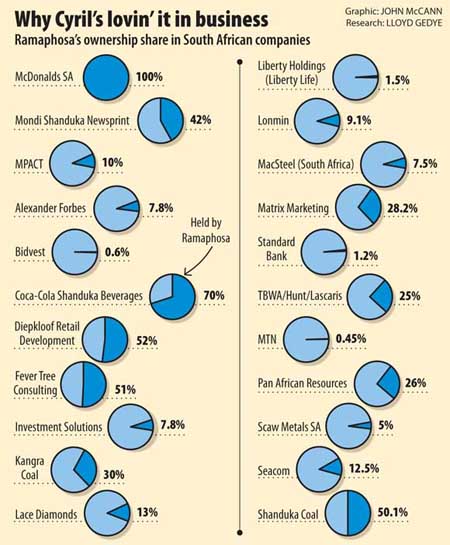
It is said we live in a democratic country; but, believe me it is for the chosen few. Current Deputy President of South Africa, Cyril Ramaphosa, was once widely considered a hero of the working class. Today he is a hypocrite and traitor to us, the majority.
From 1994, when his career as a trade unionist ended and his career as a capitalist and state politician began, he has enriched himself at the expense of workers – he is a billionaire by the toil of our mothers, fathers, brothers and sisters.
Ramaphosa played a major role in the National Union of Mineworkers (NUM), in the Congress of South African Trade Unions (COSATU) and in the negotiations leading to the 1994 breakthrough. He became African National Congress (ANC) secretary-general in 1991 and ANC deputy president in 2012 – the ally of President Jacob Zuma.
In the years between, his business empire has grown massively. His interests now include a big stake in the Lonmin platinum mines; he is implicated in the 2012 Marikana Massacre of striking miners near Rustenburg. As a result, he had to testify at the Farlam Commission in Centurion, Tshwane, which recently ended.
This makes me wonder what kind of democracy and equality he was fighting for. He was a hero of the anti-apartheid struggle, but is now a villain of the parliamentary democratic period. He is covered with an indelible and negative stigma amongst the majority of South Africans.
But one may not be surprised: even his leader and ally, Jacob Zuma, runs the state with filthy hands, part of the large group of corrupt state officials and capitalists that loots our country.
In conclusion, all these so-called leaders are wolves in sheep’s clothing. And all that glitters, dear readers, is not gold! Parliament, rather than being a solution, is a place where the wolves come out to feast. This system of hierarchical rule always changes those people who join it. It is up to us, the working class majority – employed and unemployed – to change the system. Anarchism shows us the way.
West Rand Municipal Workers Fight Wage Cuts
By Mzee (TAAC)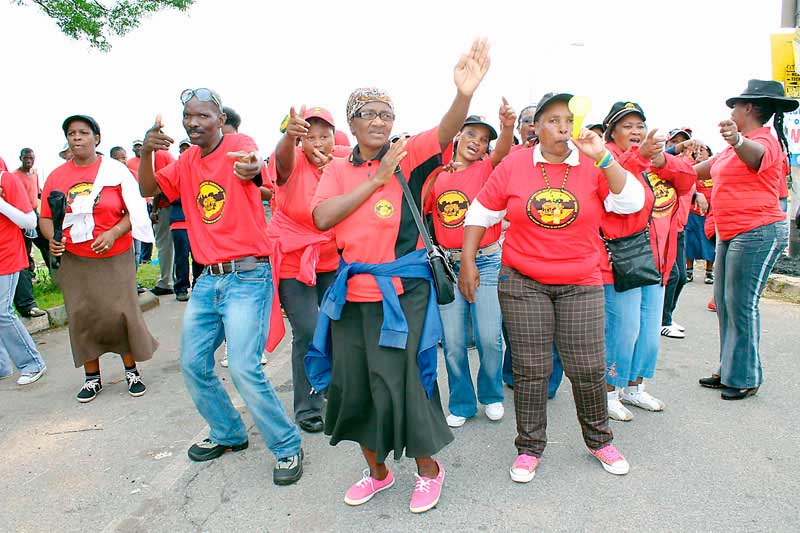
Workers in the Public Safety department of the West Rand District Municipality, Gauteng, are experiencing extremely stressful times. This is mainly due to management’s actions. There have been many cases of resignations and stress-related illnesses – and some workers have been affected badly enough to commit suicide.
Management has continually turned a blind eye to the problems. It is a major employer, as the municipality is a large one, covering mining areas like Carletonville, Khutsong, Krudersdorp, Randfontein and Westdriefontein and rural areas like Magaliesberg and Muldersdrift.
Working Class Livelihoods: Struggle against Each Other, or Revolt against the System?
 by Bongani Maponyane (TAAC, ZACF)
Rising inflation means increases in food and petrol prices. Inflation is a global problem, driven partly by conglomerates maximising their profits at the expense of ordinary people. The state plays its role, continually raising prices for services.
The pressure of capitalism has impacted on our lives. It has caused clashes within the working classes, resulting in discrimination and prejudice. Ruling class elites – the political and economic elite – benefit from these struggles between people who compete for scraps from their tables.
 zabalaza.net