Chile and Haiti after the earthquakes: so different yet so similar…

by José Antonio Gutiérrez D.

I.

Chile has again been hit by an earthquake of apocalyptic magnitude, like in the earthquakes of 1938, 1960 and 1985. With the precision of a Swiss watch, the centre and south of the country is hit every 25 years by a seismic movement that puts the country in a state of deep shock. The earthquake we saw on 27 February was one of the strongest recorded in history – 8.8 degrees on the Richter scale, 9 on the Mercalli scale.

Chilean earthquake 1The anguish of not knowing anything about our loved ones, of not being able to communicate with them, has followed the destruction, the isolation and death or disappearance of a great many people. Impotence is a shadow hanging over the heart. The death toll is now at about 700 – some are saying that they expect a final figure of about 2,000 when we eventually get the full picture of the devastation. Nothing is known yet about many in the affected provinces in the regions of Maule and Bío Bío. When people were still talking of about 300 killed, we learnt that the Constitución tsunami had swallowed up around 350 inhabitants, doubling the death toll. And we now know there were other places hit by tsunamis, though the extent of the damage is still unknown.

Continue reading

Obama’s Imperial War: An Anarchist Response

by Wayne Price (NEFAC, USA)

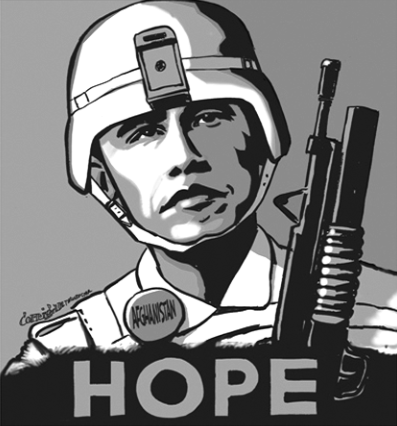
The expansion of the United States’ (US) attack on Afghanistan and Pakistan is not due to the personal qualities of Obama, but to the social system he serves: the national state and the capitalist economy. The nature of the situation guarantees that the system will act irrationally. Anarchists should participate in building a broad movement against the war, while raising our political programme.

Obama and "Hope"In discussing President Obama’s expansion of the US attack on Afghanistan and Pakistan, it is important not to focus on Obama as a personality, but on the social system to which he is committed, specifically to the war-waging capitalist national state. “War is the health of the state,” as Randolph Bourne declared during World War I. It is what the national state is for, what it does, and why it still exists, despite the real trends toward international unity and worldwide coordination. In an age of nuclear bombs, the human race will not be safe until we abolish these states (especially the big, imperial ones such as those of North America, Western Europe and Japan) and replace them with a federation of self-managing associations of working people.

After 3 months of consultations and deliberation, President Obama announced that he is going to do what he had promised to do during his campaign for the presidency — namely to expand the US attack on Afghanistan and Pakistan. This may not have been inevitable (since he broke many of his campaign promises already, such as ending overseas prisons, openness in government, ending the “don’t ask, don’t tell” policy of silence on homosexuality in the military, a health care plan which covers everyone, an economic plan for working people, etc.). But it was probable.

Continue reading

Anarchism vs. Liberalism: whose powers are “separate”?

by James Pendlebury and Sian Byrne (ZACF)

In liberal political theory – a favoured ideology of many capitalist states – an important principle is that the functions of government are divided into three “spheres” or “branches”:

  • The legislature (national and provincial parliaments, local councils) makes the laws;
  • the executive (ministers, officials, cops and soldiers, who report to the president or premier) carries out the laws;
  • the judiciary (courts) decides what the laws mean when there is some dispute.

Whose Powers are seperate?In states with written constitutions (including the United States, South Africa and many others) an important task of the courts is to decide whether laws passed by parliament (the legislature), or actions taken by the executive, are allowed by the constitution. (Some liberal states, such as Britain, do not have written constitutions; there the power of the courts is officially more limited.)

A key principle of the ideology of liberalism is “the separation of powers”. Each of the three branches, the liberals tell us, is entitled to autonomous responsibility for certain functions that do not overlap, or cannot be interfered with by the other spheres. The reason for this, it is argued, is that the people who make the laws shouldn’t be the same as those who interpret them or those who enforce them, and so on. No single person or group should have all the power. In this way, liberals hope to limit the powers of the state, which they recognise as a threat to freedom.

Continue reading

The Industrial and Social Foundations of Syndicalism

This is an extract of a speech called “(De)constructing Counter-power” given at five universities in Canada in March 2010 by Michael Schmidt, co-author with Lucien van der Walt of Counter-Power, a challenging new two-volume study of anarchist theory, tactics, strategy and history. The first, theoretical volume, Black Flame: The Revolutionary Class Politics of Anarchism and Syndicalism (AK Press, USA, 2009), has received largely constructive reviews from the global activist, academic and labour press (see http://black-flame-anarchism.blogspot.com/). Schmidt was kindly hosted by the Wilfrid Laurier University, the Centre for the Study of Theory & Criticism at the University of Western Ontario, McMaster University, the University of Ottawa, and the University of Toronto. His talks were warmly acclaimed – not without comradely criticism – and his audiences consisted in part of anarchist-communists of ZACF sister organisations Common Cause (Ontario, Canada), the Union Comuniste Libertaire (Quebec, Canada) and the North-Eastern Federation of Anarchist-Communists (USA), plus platformists Juventud Libertaria (Mexico), libertarian Marxists such as Gramsci is Dead author Richard Day, members of the hardline Communist Party of Canada and of the (Trotskyist) International Bolshevik Tendency.


Ever since the revolutionary vision that is anarchism gained a foothold in the imagination of the popular classes with the rise of syndicalism within the ranks of the trade unions affiliated to the First International in about 1868, it has provided the most devastating and comprehensive critique of capitalism, landlordism, the state and of unequal social power relations in general, whether gender-based or rooted in racism, colonialism or other forms. In their place it has offered a practical set of tools whereby the oppressed of the world can challenge the dominance of the tiny, heavily armed elites that exploit them. As such, anarchism and syndicalism – together what we have termed in Counter-Power Volume 1, Black Flame, “the broad anarchist tradition” – was not only the most implacable enemy of the rise of the industrialists and landed gentry who were the ruling class antagonists in the state/capitalist modernisation project in most countries, but it unalterably shaped class struggle in the late 19th and early 20th Centuries, producing several key effects that we today presume to be fundamental aspects of civilised society.

Continue reading

Zabalaza #11 (October 2010)

Zabalaza 11
Click above to download the PDF

Contents:

  • Editorial – by the Zabalaza Anarchist Communist Front

South Africa:

Continue reading

All in the Name of the Beautiful Gain

Phansi Fifa, Phansi!A ZACF statement on the 2010 Soccer World Cup
in South Africa

The 2010 Soccer World Cup must be exposed for the utter sham that it is. The ZACF strongly condemns the audacity and hypocrisy of the government in presenting the occasion as a “once-in-a-lifetime” opportunity for the economic and social upliftment of those living in South Africa (and the rest of the continent). What is glaringly clear is that the “opportunity” has and continues to be that of a feeding-frenzy for global and domestic capital and the South African ruling elite. In fact, if anything, the event is more likely to have devastating consequences for South Africa’s poor and working class – a process that is already underway.

In preparing to host the world cup the government has spent close to R800 billion (R757 billion on infrastructure development and R30 billion on stadiums that will never be filled again), a massive slap in the face for those living in a country characterized by desperate poverty and close to 40% unemployment. Over the past five years the working poor have expressed their outrage and disappointment at the government’s failure to redress the massive social inequality in over 8000 service delivery protests for basic services and housing countrywide. This pattern of spending is further evidence of the maintenance of the failed neoliberal capitalist model and its “trickle down” economics, which have done nothing but deepen inequality and poverty globally. Despite previous claims to the contrary, the government has recently admitted this by doing an about turn, and now pretends that the project was “never intended” to be a profit making exercise [1].

Continue reading