Organisational Dualism, Active Minority and the discussion between ‘Party’ and ‘Mass Movement’

Anarchist Federation of Rio de Janeiro – FARJ (Brazil)

Mikhail Bakunin
Mikhail Bakunin

The term “organisational dualism”, as it is used in English, serves to explain the conception of organisation that we promote, or what has classically been called the discussion between “party and mass movement”. In short, our especifista tradition has its roots in (Mikhail) Bakunin, (Errico) Malatesta, Dielo Truda (Workers Cause), Federación Anarquista Uruguaya – FAU (Anarchist Federation of Uruguay) and other militants/organisations that have defended this distinction between levels of organisation. That is, a broad level that we call the “social level”, composed of popular movements, and that which we call the “political level”, composed of anarchist militants that are grouped around a defined political and ideological basis.

This model is based on a few positions: that popular movements cannot be confined to a defined ideological camp – and, in this respect, we distinguish ourselves from the anarcho-syndicalists, for example – because they should organise themselves around needs (land, shelter, jobs, etc.), grouping together large sectors of the people. This is the social level or the mass movement, as it has been called historically. The model also contends that, to work in movements, it is not enough to be dissolved – or inserted – in them, even while recognising ourselves as anarchists. It is necessary that we be organised, constituting a significant social force that will facilitate in the promotion of our programme and also in defence against attacks from adversaries that have other programmes. However, one must bear in mind that we do not promote participation in one or other level; anarchists are also workers and are part of this broad group that we call the exploited classes and, therefore, they organise themselves, as a class, in the social movements. Even so, as this level of organisation has its limitations, the anarchists also organise themselves on the political level, as anarchists, as a way to articulate their work and ideas.


Continue reading

What Anarchism and Syndicalism offer the South African Left

Lucien van der Walt

The 21st century is a time of both despair and hope: despair at the evils of contemporary society, hope that a new world is possible.

The ideas of the broad anarchist tradition can contribute greatly to this new world. They are integrally tied to an inspiring body of practice in working class, anti-capitalist, anti-imperialist and civil rights struggles, back to the 1860s. And they are relevant to South Africa today.

Aims

Anarchism’s basic aim is the most complete realisation of a revolutionary democratic vision, abolishing hierarchy and exploitation:

  • ending social and economic inequality, including by race, nation and gender, to create a society based on free, cooperating individuals;
  • revolutionary reconstruction of the family as a site of freedom and cooperation;
  • participatory-democratic control of the means of production, coercion and administration, through multi-tendency worker/ community councils, not corporations and states; and,
  • self-management at work, global economic participatory planning, and distribution on the basis of need, not markets.

Continue reading

Without bosses: the Process of Recovering Companies by their Workers in Argentina, 2001-2009

by Red Libertaria de Buenos Aires *

Introduction

Self-management in Argentina

From late 2001 and the beginning of 2002, sectors of the Argentine working class staged an extraordinary experience of struggle. The occupation of companies and the commencing  of production without bosses. In the context of an economic crisis, high levels of unemployment, bankruptcy of companies and massive retrenchments, thousands of workers organised themselves to keep their jobs.

Economic and Political Crisis

Between 1997 and 2001 there was a severe economic crisis in Argentina that impacted heavily on the bloc in power. This crisis was surmounted by a popular rebellion on the 19th and 20th of December that, facing a state of siege, forced the resignation of President Fernando De la Rúa and the opening of a process of leaderlessness in the executive branch of the Republic [1], and an advancement of popular struggle. This rebellion put an end to a series of neoliberal governments in the country, while there was a breakthrough in popular struggle: neighborhood assemblies, movements of unemployed workers and the recovery of factories and businesses by workers.

Continue reading

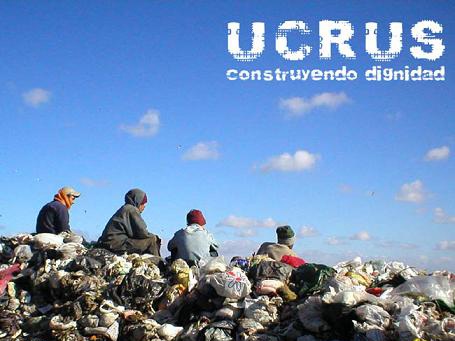
Picking Up the Slack in Waste Collection and Ecological Protection: the Struggle of Recyclable Waste Pickers in Uruguay and Brazil

by Jonathan Payn (ZACF)

Across South America there is a growing movement – assuming different forms and characteristics, but with similar origins, demands and objectives – that, despite it being located at a strategically important intersection between two critical social issues – class struggle and ecology – seems to me to have received little attention in South African academic and activist circles. And this is true despite the fact that the social and economic conditions that gave rise to this movement prevail in South Africa, as they did – and continue to – in many South American countries. Perhaps this is due to the fact that this movement concerns people largely marginalised by industrial society and so-called ‘brown’ ecological issues – such as the pollution and contamination of rivers and dams surrounding poor communities, most acutely effecting the workers and poor – as opposed to the much more sanitary ‘green’ ecological issues – such as conservation and animal welfare – often associated, in South Africa at least, with liberal white activists from the middle and upper classes [1].

This is the movement of the catadores, as they are known in Brazil, and clasificadores in Uruguay; the recyclable waste pickers and sorters who, similarly to South Africa, constitute a growing informal sector in the industrial production cycle. This includes all people – not formally employed by public or private waste management services – who collect, transport, classify and sell recyclable waste for a living – or ‘work with scrap’ – thus “reducing demand for natural resources and reducing greenhouse gas emissions” [2]. A category of work which, according to the World Bank, is performed by 15 million people globally – or one percent of the world population [3] – and has become increasingly common in South Africa in recent years.

Continue reading

Build a Better Workers’ Movement: learning from South Africa’s 2010 mass strike

Lucien van der Walt and Ian Bekker

The biggest single strike since the 1994 parliamentary transition in South Africa showed the unions’ power. It won some wage gains, but it threw away some precious opportunities. We need to celebrate the strike, while learning some lessons:

  • the need for more union democracy
  • the need to use strikes to link workers and communities
  • the need for working class autonomy
  • the need to act outside and against the state
  • the need to review our positions: against the Tripartite Alliance, for anarcho-syndicalism

Continue reading

Zabalaza 12 Editorial

zacf logoThis issue of Zabalaza (no. 12) comes out in a period characterised by significant political changes and transitions. On the international terrain, the uprisings in North Africa and the Middle East, which began in late 2010 but have continued into recent months, have been a key topic of discussion – in both the mainstream media and in activist circles. There has been a tendency for these to be portrayed in the media simply as “struggles for democracy”. Likewise, the media often reproduce an incomplete version of events – depicting the uprisings as “coming out of nowhere”. In fact, in many cases the demands of the masses have raised far more profound questions about the basic distribution of both wealth and power in society, and are the culmination of struggles that go back some ten years, by both the masses and organised labour, around high unemployment, rapidly rising food prices, poor living conditions, open corruption by the ruling elites, and a lack of basic political freedoms (produced in part by the introduction of neoliberal reforms). In this issue we focus attention on the Egyptian case, looking specifically at the possibilities the situation holds for the future.

Continue reading

Zabalaza #12 (July 2011)

Download Zabalaza #12Contents:

  • Editorial – Zabalaza Anarchist Communist Front

Southern Africa

Africa

International

History

Theory

Counter-Culture/Sport

Zabalaza 11 Editorial

Zabalaza 11 has a distinct local flavour to it as compared to our previous issue. This is partly as a result of South Africa’s hosting of the 2010 Soccer World Cup, which has dominated the socio-political landscape this last year. The excessive money spent by the state on preparations for the event (before and during) highlighted, once again, a complete disregard for the plight of the working poor and impoverished domestically and the stark reality of its anti-poor, pro-rich policies. Despite the tournament being ‘sold’ to the public as an economic opportunity not only for South Africans, but Africa as a whole, the major beneficiaries have been a small band of domestic and global economic and political elite.

Zabalaza 11 also focuses attention on the repression suffered by social movements based amongst some of the poorest in South Africa. In response to these attacks and subsequent arrests, the ZACF worked closely with the Poor People’s Alliance to create networks and actions of solidarity with those organisations.

Social movements have also gained and suffered at the hands of the South African judicial system recently. We focus attention on constitutional law and offer both a critique of the use of the state’s legal system by social movements as well as a way forward for embattled movements locally.

Continue reading

At the End of the Baton of South African Pretensions

by Warren McGregor (ZACF)

Post-1994 South Africa is usually seen and promoted as a country of moral and political exceptionalism. The spawn of negotiations between the bourgeois nationalist and voluntarily neo-liberal African National Congress (ANC) under the guidance of Nelson Mandela and the hierarchy of the vicious apartheid state, post-apartheid South Africa was to provide a shining example of reconciliation and socio-economic progress. During a few dark days in May 2010, these claims were finally and mercilessly put to rest. So it seems and has been for those who survive in and who are social activists at the layer of society most subject to the oppressive nature of the state and capital: the working class and poor. The Landless People’s Movement, a shack and rural township dwellers organisation based in the Gauteng province, suffered attacks at the hands of their fellow community members. These attacks were designed by local community members to harass and expel prominent local activists and to destabilise the organisation and its constructive community work. Most of the LPM’s activism is directed against the state and its representatives at a local and municipal level, and thus an attack on activists can be seen to benefit a larger state desire of quietening social movements throughout the country. Lack of initial police intervention to prevent further attacks on the night of the attacks, and the subsequent arrest of prominent community activists speak to this desire.

The attacks on social movements and activists should be viewed within a socio-economic context that sees South Africa as one of the most unequal societies on the planet (according to its Gini coefficient – the income inequality indicator, literally the gap between the rich and poor). This inequality persists, bred during the last century and exacerbated by the ANC government’s grasping at neo-liberalism. Added to this cauldron of inequality was the morally criminal and immense spending by the state in hosting the recent 2010 FIFA Soccer World Cup which revealed what the staging of the event was designed as and who it ultimately will benefits –  a capitalist and corporate state project for the benefits of the very few (domestically and globally).

Continue reading

Electricity Crisis in Protea South

by Lekhetho Mtetwa (ZACF)

It was on Sunday morning, the 28th of April 2010 when people from the bond houses took out illegal connections in Protea South. They were returning from a funeral when they made these disconnections by removing electricity wires.

The person who brought them to my yard, framing me as the one in charge of illegal connections, is a taxi owner named Nkosi. He kept on saying illegal connection meetings are held in my yard, as he often saw people gathered outside my yard connecting. The question is: do I have the powers to stop all people living in the informal settlement from connecting electricity? No! I don’t have any power to stop them. Only Eskom could maybe do that with the help of the state.

I was also threatened that if the main electricity box is burnt, they’ll also burn my shack. On that night people wanted to burn the main box and I contacted the Landless Peoples’ Movement (LPM) comrades to check what was happening outside our shacks. There we found angry community members planning to wake the rest of the people of the informal settlement to go and burn the box. We tried our best to stop them from burning the box and they all listened, although they were not satisfied.

Continue reading