by Mandy Moussouris and Shawn Hattingh
Everything we are now is built upon all that we were and where we came from. The same can be said for countries, any analysis has to look backwards before it can begin to understand the influences and causes of the present. This makes analysis intrinsically complex and often, almost impossible. At some point we are forced to simplify, look for patterns and analyse situations with a focus on where the key locus of power lies.
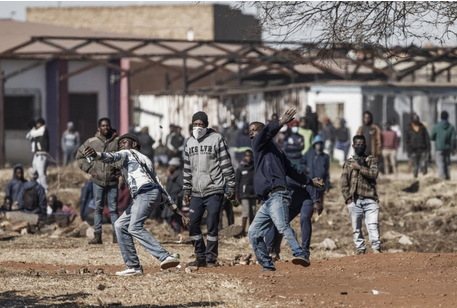
An analysis of the recent events taking place primarily in Kwa-Zulu Natal and Gauteng has to be done with this in mind. It is impossible to follow every strand of the complexity that is South Africa, but at the same time the link between the spate of large scale looting that took place and two very obvious conflicting ruling class power bases that currently exist in the country is undeniable. To claim that there was an exercising of working class power is to fundamentally misunderstand the powers at play and where the locus of power at this point in history actually lies.
 We are living in a world that for most people is broken and that has broken most people. It is not a god given world, but one that has been constructed by those in power and that has left most people mired in deprivation. Under COVID-19, this world has sunk to new lows.
 The question of state government elections and running a workers or socialist political party continues to be raised in the working-class movement and the Left globally. As we may know, there was excitement about the rise of Jeremy Corbyn in the Labour Party in Britain, about the successes of left political parties in certain parts of Europe and Latin America and, more recently, certain shifts to more centrist positions in the United States amongst a section of the Democratic Party calling themselves “Democratic Socialists.” In South Africa, many workers and some activists seem cautiously optimistic about NUMSA’s formation of the Socialist Revolutionary Workers Party that participated in the 2019 general elections, but did not manage to get a seat in Parliament.
 In examining the possibilities for politics within and at a distance from the state, it is important to revisit the democratic traditions of the working class, which are often learned through struggles and strikes – and which were exemplified by the new unions of the 1970s and 1980s. Not much of this alternative tradition of democracy outside the state has been captured in official histories, which present the attainment of democracy in terms of the formation of a parliamentary government in 1994.
 A video went viral on social media platforms on October 3, outlining how the notorious Special Anti-Robbery Squad (SARS) unit of the Nigerian police force shot a young man, dumped him at the side of the road and stole his car. What followed was three weeks of protests by young people against such police brutality and the corruption that defines the state; initially via social media, #EndSARS, and later in towns and cities across Nigeria.
 Centred on the Congress of South African Trade Unions (COSATU), and within it, key unions like the National Union of Metalworkers of South Africa (NUMSA), the unions developed an ideological and strategic orientation described by scholars (e.g. Eddie Webster and Glenn Adler, 2000) as “radical reform” or “structural reform.” The thinking of the main unions in South Africa remains, to this day, profoundly shaped by the “radical reform” (RR) model.
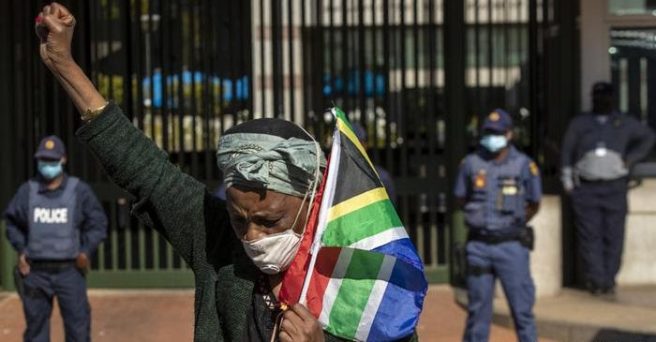 In the midst of the COVID-19 pandemic, it often seems as if we are stuck in a dystopian movie. In this movie death is stalking us, hospitals overflow with the sick and dying, and the grave diggers are at work. We know more victims will soon die as the folly of millions of workers being forced by circumstances to return into cramped mines, banks, factories and warehouses is so evident. Those that are no longer needed by the billionaires who own the companies are marshalled daily by the police and military dishing out violence and on occasion, humiliation, to underline their power and the power of their bosses.
 The ongoing capitalist crisis, and the impacts of COVID19, have made it clear that the capitalist and state system we live under is neither efficient nor just. Inequality has hit record levels and a small elite has more wealth than ever, while the very basics – such as a decent healthcare, water, housing, sanitation, food and electricity – cannot be effectively financed, run nor delivered. Politicians in every state abuse their power too and corruption is rife, only its severity varies. Parliamentary democracy is largely hollow with a majority of people having no real political power. The oppression of women and people of colour continues unabated and imperialism deepens everyday. Due to the ever-expanding nature of capitalism the ecology is on the verge of collapse. It is clear a movement for change and an alternative to capitalism and the state system is needed.
 The crisis of the statist politics that dominated working-class politics — social democracy, Marxism-Leninism, and anti-imperialist nationalism — and the rise of neoliberalism, has aided the rediscovery of society-centred, anti-capitalist forms of bottom-up change “at a distance” from the state.
 zabalaza.net