Mutiny Zine recently interviewed Jonathan, international secretary of the Zabalaza Anarchist Communist Front (ZACF), about the police massacre of workers who were on strike at the Lonmin company’s mines in Marikana in South Africa. For information about ZACF, see https://zabalaza.net/
Author: griffin36

Whose State is it; and What is its Role?
by Shawn Hattingh
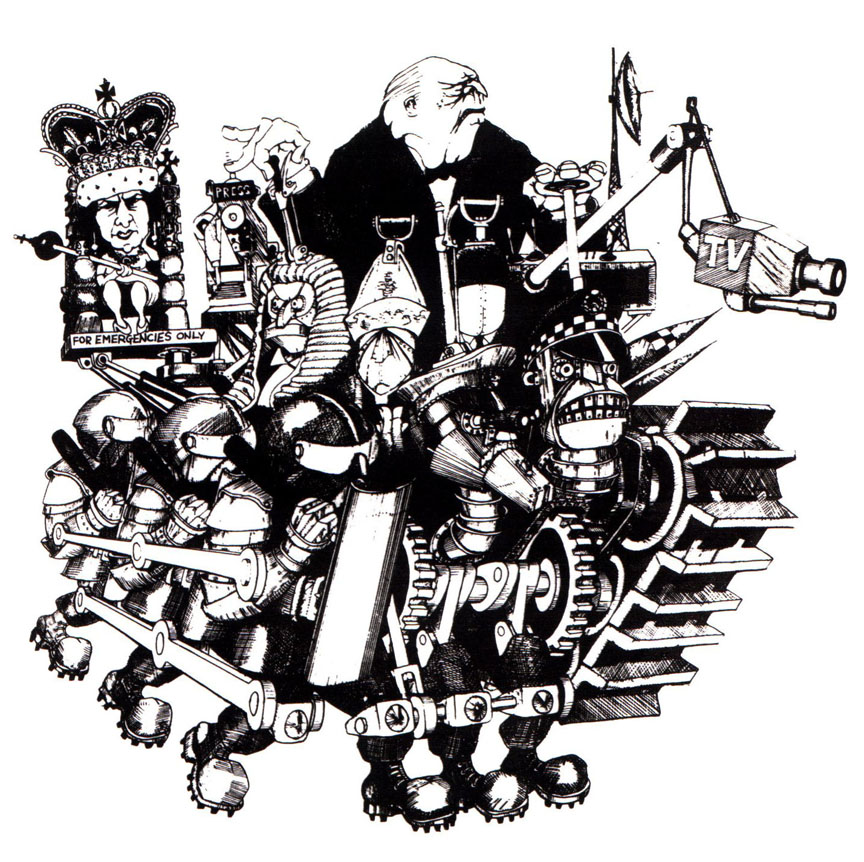 The South African state’s oppression of the ongoing wildcat strikes, including at Marikana, is clearly deepening. Over the weekend, troops were deployed in the platinum belt in what has been a barefaced bid by the state to stop the protests by striking workers, and essentially force them back to work. As part of this, residents at the informal settlement at Marikana have been subjected to a renewed assault by the police. Many residents in the process were shot with rubber bullets; their homes were raided; and tear gas, at times, lay over the settlement like a chemical fog. In practice, a curfew has also been put in place and anyone gathering in a group has been pounced upon by the men in blue. Threats have also emerged from the Cabinet that a crackdown on any ‘trouble-makers’, that are supposedly inciting workers to continue to strike, is going to happen.
Sugar Coating Exploitation
 by Shawn Hattingh
This article explores, from an anarchist perspective, the sugar industry in southern Africa, and how the two dominant companies – Illovo and Tongaat-Hulett – exploit and oppress workers and communities surrounding their operations.
Southern Africa has become well known for being one of the cheapest places to produce sugar. Consequently, million of tons are produced in the region every year. Two companies have come to dominate much of this lucrative industry: Illovo Sugar and Tongaat-Hulett. It is little wonder (given how profitable the sector is), that in 2012 these two South African headquartered sugar giants once again declared massive annual profits. In fact, Illovo and Tongaat-Hulett have been reaping in billions of Rands from their operations in South Africa, Mozambique, Zimbabwe, Tanzania, Malawi, Zambia and Swaziland over the years.
In Sunny St-Imier! Ep. 3: Zabalaza Anarchist Communist Front
Interview with Warren of the Zabalaza Anarchist Communist Front done at the St. Imier international anarchist meeting about the importance of forging both organisational and personal ties with comrades around the world. In addition Warren sheds some light on the origins of anarchism in Africa. Interviewed by Adrien of the ZACF’s sister organisation Motmakt from Norway.
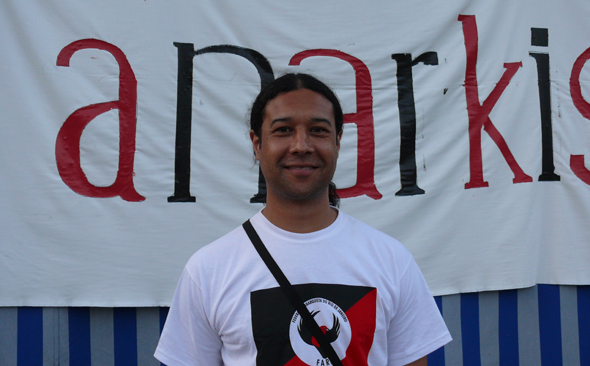
Warren in front of the Anarkismo tent in St-Imier
Transcript of the interview
Motmakt: I’m here in beautiful St-Imier, Switzerland. And we have taken refuge from the sun and are drinking a little bit of beer and are having a great time. I am here with Warren from the Zabalaza Anarchist Communist Front, and I was wondering Warren how did you hear of the St-Imier conference?
What the Marikana Massacre tells us
by Shawn Hattingh
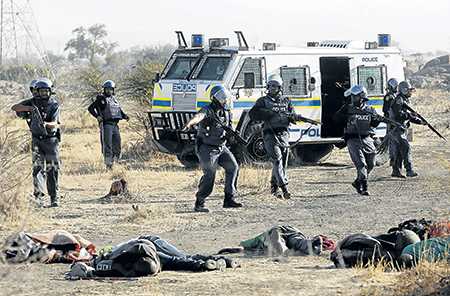 The sight of policemen brutally gunning down striking mineworkers at Marikana was truly galling. At the very least 300 rounds of live ammunition were fired at workers (and not only those seen on TV) by the police using automatic assault rifles in a military style operation [i]: the infamous consequences being 34 workers killed and perhaps as many as 87 injured [ii], with some workers still unaccounted for [iii]. Many of the workers were also reportedly shot in the back [iv] and some executed [v]. To add insult to injury, and with what was clearly some relish, the police arrested 260 workers in the aftermath [vi]. This often even involved policemen literally sticking the boot into injured workers. Allegations have also subsequently emerged that 190 of these arrested workers were tortured, some for up to 3 days, whilst being held in surrounding police stations [vii]. One worker also claims that he was taken to a room on Lonmin’s property, who owns the mine at Marikana, and handcuffed to a chair and beaten with a rubber pipe by police in a bid to extract information about the ‘leaders’ of the wildcat strike [viii]. Not to be outdone in callousness, Lonmin issued an ultimatum that unless the rest of the striking workers returned to work by 7am on the 21st of August disciplinary actions would be taken against them [ix]. The strikers though have ignored Lonmin’s threats, and at the time of writing, most remained out on strike [x].
ANC Throws Off Its Mask! Workers Murdered!
South African anarchist statement on the Marikana Massacre
Joint statement on the Marikana Massacre issued by the Tokologo Anarchist Collective, Zabalaza Anarchist Communist Front and Inkululeko Wits Anarchist Collective.
 A4 double-sided Flyer
Download here
Afrikaans | isiZulu | seTswana

ANC Throws Off Its Mask! Workers Murdered!
Capitalists and politicians guilty! Stop police brutality.
No justice, no peace. No Zuma, no Malema, no LONMIN!
The Constitution promises political rights and equality. It is quite clear that the bosses and politicians do exactly as they wish. They walk on the faces of the people. This is shown by the police killings of strikers at Lonmin’s Marikana mine. Continue reading
Venezuela and the ‘Bolivarian Revolution’: Beacon of Hope or Smoke and Mirrors?
by Shawn Hattingh (ZACF)
 Introduction
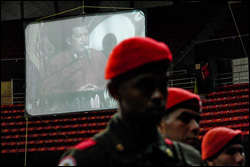
For many people on the left, within and outside of Southern Africa, the ‘Bolivarian Revolution’ is seen as a beacon of socialist hope in a sea of capitalist despair [1]. The reason why many leftists feel so strongly attached to this project, and promote it as an alternative, is because they have come to view it as a move by the Venezuelan state towards creating a genuine, free form of socialism [2] or at the very least an experiment that profoundly breaks with the tenets of neo-liberalism [3] [4]. Many articles have, therefore, been written lauding the state’s nationalisation of some industries [5], its land distribution programmes [6], and its attempts to supposedly create participatory democracy in workplaces (through co-management and co-operatives) [7] and in communities (through community councils) [8]. Linked to this, a great deal has also been made of the state using some of revenue generated by the Petróleos de Venezuela (PDVSA) to roll out social services such as education, subsidised foodstuffs and healthcare [9]. Much ink has, consequently, been spilt arguing that all of these are socialist inspired moves and passionate calls have been made for other states, like the South African state, to adopt Venezuelan style ‘Socialism for the Twenty First Century’ [10].
Class War and Imperialism in Greece
by Shawn Hattingh (ZACF)
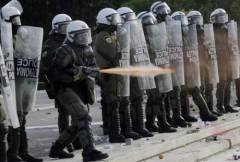
As the crisis in Europe has intensified, class war and imperialism have deepened in Greece. Indeed, the Greek working class has been subjected to further attacks from the local ruling class – comprised of capitalists and high ranking state officials – and imperialist powers. In order to receive the latest ‘bailout’ from the International Monetary Fund (IMF) and European Central Bank (ECB), a bailout that goes straight to the banks that own most of the Greek state’s debt, the Greek state was told by the German, French and US ruling classes to once again reduce pensions by more than 15%, to fully privatise public utilities, to yet again cut social spending, and to implement more wage cuts, including a 22% reduction in the minimum wage. By 2014 it is planned that the Greek state would have cut spending, mostly on social services, by a further 12 billion Euros. All of this has come on the back of earlier rounds of austerity measures and the Greek working class has been under severe pressure: homelessness has been growing at a rapid rate and the unemployment rate has shot past 20%.
The 2012 Budget: by the Ruling Class for the Ruling Class
by Shawn Hattingh (ZACF)
 Once again much media fanfare has broken out in aftermath of the South African state’s budget speech. The budget, however, is yet more proof of the ANC’s ruling class agenda: free markets, budget cuts for the poor and subsidies for the rich. From the budget and other utterances it is clear the ANC has, despite media hysteria, no interest in nationalisation. The state will, therefore, try and deal with the global economic crisis largely through business-as-usual.
The business media, however, has fallen all over itself with the news, from the budget, that the state will be spending billions of Rands on infrastructure and the development of ‘Special Economic Zones’, supposedly to create employment and help the poor to find a job. Much too has been made of the state spending over 50% of the budget on social services. Messages, from the state and the private media, and from the party leaders of the SACP and ANC, have been about how the budget is intended to help the poor and drive job creation. The Minister of Finance, Pravin Gordhan, has been presented as giving hope to the dispossessed, and as giving a helping hand to the most marginal sections of society through the budget. Since, however, the budget does nothing to remove the causes of poverty, the welfare part of the budget is in reality about providing tiny grants and propping up crumbling state hospitals and township schools.
Towards a Truly Democratic Left: An Anarchist Assessment of the DLF at COP17
by Jonathan Payn (ZACF)
Failures of democracy have been a big part of the history of the DLF. We in the Zabalaza Anarchist Communist Front (ZACF) have had to raise such challenges several times (see “DLF structure: concerns and proposals” by ZACF). We have long been troubled by the lack of proper democratic structures, by a leadership that consists far more of middle-class intellectuals than of grassroots militants, and by a programme that seems to be determined in advance by the academic and NGO interests of these intellectuals instead of by the immediate needs of the workers and the poor.
 zabalaza.net