 The question of state government elections and running a workers or socialist political party continues to be raised in the working-class movement and the Left globally. As we may know, there was excitement about the rise of Jeremy Corbyn in the Labour Party in Britain, about the successes of left political parties in certain parts of Europe and Latin America and, more recently, certain shifts to more centrist positions in the United States amongst a section of the Democratic Party calling themselves “Democratic Socialists.” In South Africa, many workers and some activists seem cautiously optimistic about NUMSA’s formation of the Socialist Revolutionary Workers Party that participated in the 2019 general elections, but did not manage to get a seat in Parliament.
With this in mind, we need to look at issues of social transformation within the framework of what we want to achieve and the relationship between the means and ends of struggle in pursuit of these aims. The historic and ultimate socialist end is a society characterised by collective democratic control of the political and economic systems and one without class divisions and oppression of any kind – in real terms, a society without the state and capitalism in particular.
If this is so, is this revolutionary transformation possible by means of state power and political parties that aim to capture this form of power?
Download PDF here
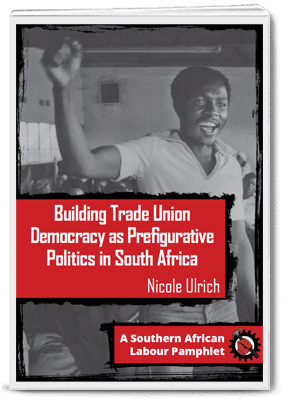 In examining the possibilities for politics within and at a distance from the state, it is important to revisit the democratic traditions of the working class, which are often learned through struggles and strikes – and which were exemplified by the new unions of the 1970s and 1980s. Not much of this alternative tradition of democracy outside the state has been captured in official histories, which present the attainment of democracy in terms of the formation of a parliamentary government in 1994.
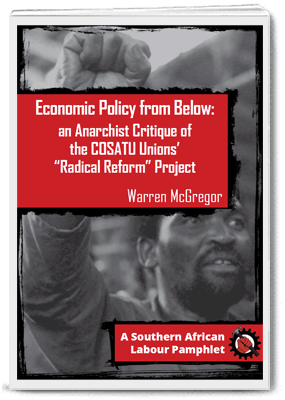 Centred on the Congress of South African Trade Unions (COSATU), and within it, key unions like the National Union of Metalworkers of South Africa (NUMSA), the unions developed an ideological and strategic orientation described by scholars (e.g. Eddie Webster and Glenn Adler, 2000) as “radical reform” or “structural reform.” The thinking of the main unions in South Africa remains, to this day, profoundly shaped by the “radical reform” (RR) model.
 zabalaza.net