 The question of state government elections and running a workers or socialist political party continues to be raised in the working-class movement and the Left globally. As we may know, there was excitement about the rise of Jeremy Corbyn in the Labour Party in Britain, about the successes of left political parties in certain parts of Europe and Latin America and, more recently, certain shifts to more centrist positions in the United States amongst a section of the Democratic Party calling themselves “Democratic Socialists.” In South Africa, many workers and some activists seem cautiously optimistic about NUMSA’s formation of the Socialist Revolutionary Workers Party that participated in the 2019 general elections, but did not manage to get a seat in Parliament.
With this in mind, we need to look at issues of social transformation within the framework of what we want to achieve and the relationship between the means and ends of struggle in pursuit of these aims. The historic and ultimate socialist end is a society characterised by collective democratic control of the political and economic systems and one without class divisions and oppression of any kind – in real terms, a society without the state and capitalism in particular.
If this is so, is this revolutionary transformation possible by means of state power and political parties that aim to capture this form of power?
Download PDF here
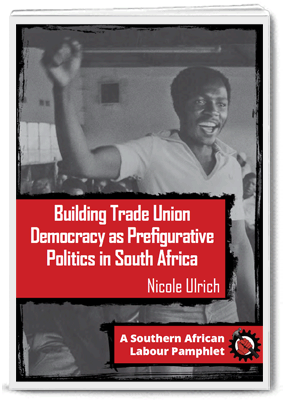 In examining the possibilities for politics within and at a distance from the state, it is important to revisit the democratic traditions of the working class, which are often learned through struggles and strikes – and which were exemplified by the new unions of the 1970s and 1980s. Not much of this alternative tradition of democracy outside the state has been captured in official histories, which present the attainment of democracy in terms of the formation of a parliamentary government in 1994.
 The ongoing capitalist crisis, and the impacts of COVID19, have made it clear that the capitalist and state system we live under is neither efficient nor just. Inequality has hit record levels and a small elite has more wealth than ever, while the very basics – such as a decent healthcare, water, housing, sanitation, food and electricity – cannot be effectively financed, run nor delivered. Politicians in every state abuse their power too and corruption is rife, only its severity varies. Parliamentary democracy is largely hollow with a majority of people having no real political power. The oppression of women and people of colour continues unabated and imperialism deepens everyday. Due to the ever-expanding nature of capitalism the ecology is on the verge of collapse. It is clear a movement for change and an alternative to capitalism and the state system is needed.
 This is a lightly edited transcription of a talk given by Prof. Lucien van der Walt on a panel on the eve of the 2019 national elections in South Africa: the International Labour Research and Information Group (ILRIG)/ Workers World Media Productions (WWMP) Public Forum, Isivivana Centre, Khayelitsha, Cape Town, South Africa 25 April.
 Twenty-five years into democracy the black working class majority in South Africa has not experienced any meaningful improvements in its conditions. The apartheid legacy of unequal education, healthcare and housing and the super-exploitation of black workers continues under the ANC and is perpetuated by the neoliberal policies it has imposed.
 The question of state government elections and running a Workers or Socialist political party continues to be raised in the working class movement and the Left globally. As we may know, there was excitement about the rise of Jeremy Corbyn in the Labour Party in Britain, left political parties in certain parts of Europe and Latin America and, more recently, certain shifts to more centrist positions in the United States amongst a section of the Democratic Party calling themselves “Democratic Socialists”. In South Africa, many workers and some activists seem cautiously optimistic by NUMSA’s formation of the Socialist Revolutionary Workers Party that will seek to participate in the 2019 general elections.
 On 17 November 2017, the Minister of Labour announced the state intends to carry out a new round of attacks on workers and their rights. The attacks come in the form of three Labour Bills currently being considered by parliament: the Basic Conditions of Employment Bill, the National Minimum Wage Bill and the Labour Relations Amendment Bill. If passed, the changes to the labour laws these bills propose will be a major attack on workers’ rights, won through decades of struggle, and will further deepen and entrench inequality and roll back important democratic gains.
 zabalaza.net