by Lucien van der Walt
Published in “Tokologo: Newsletter of the Tokologo African Anarchist Collective”, numbers 5/6, November 2015
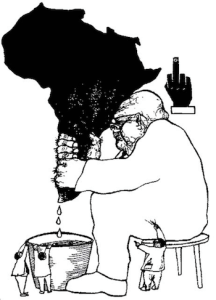 Roughly 50 years ago we saw the dismantling of most of the European colonial empires in Africa. High hopes greeted the “new nations” that merged – and certainly, a move from colonial rule, with its racism and external control and extractive economies, was progressive.
However, many of the hopes were soon dashed. Politically, most independent African states moved in the direction of dictatorships and one-party systems, normally headed by the nationalist party that took office at independence – and, over time, the military became a major player too. Many of these states were highly corrupt, even predatory, and the gap between the rising local (indigenous) ruling class, and the masses, grew ever vaster.
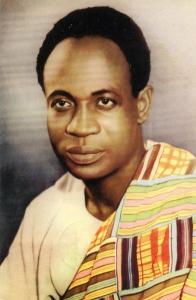 Ghana, West Africa, was a British colony called “Gold Coast” until 1957. It became the first independent country in “black” Africa after reforms and struggles in the 1940s and 1950s. The new president, the brilliant Kwame Nkrumah, and his Convention People’s Party (CPP), had fought for independence. Now they aimed at major changes in the society, even speaking of socialism. And Nkrumah proposed a united African government for the continent: Pan-Africanism.
 Cde Kusta’s untimely demise is a great loss. It will be felt by all those who were lucky to cross paths with him and all those who got to hear his music. He never questioned or withdrew his commitment to the struggle for freedom and justice, for a world with less political, economic, and gender based oppression.
 A constant fixation on the machinations of elite power manoeuvring, and persistent, recurring calls for either new leadership, or new political parties, are evidence of a very conservative and authoritarian political culture. These stories may well be important. Indeed, this is the nature of current socio-economic organisation (capitalism and the state). These human-created forms of control always operate to centralise power up the hierarchy, thus investing tremendous power in the hands of very few. This few – race, gender, rhetoric regardless – the ruling class, are those who control the means of production, administration and coercion. Our pre-occupations are drawn to such elite individuals and groups as many of us have chosen to hand over our political power and future to these. Now this political culture usually results in the general and often vain belief and hope that through hierarchical, fundamentally undemocratic organisation, leaders invested with this incredible power are somehow to create the foundations for a more equal society and world. Also important to consider is that all political parties, no matter the colour of its beret, whether in control of the state or seeking to attain this control, centralise the power of decision-making upwards, and are thus fundamentally authoritarian and anti-democratic.
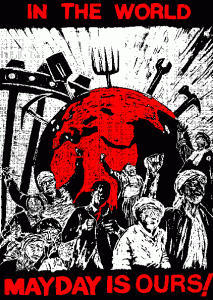 In South Africa, the black working class majority is gripped by the rough hands of its ruling class, made up of a cold combination of black state elites and white capitalist elites, who choke the very life out of her. blazing but blinded. In days like these it is important to remember our heroes, our champions of past years, to remember the stories of Ma Josie Mpama, who wanted nothing more, than to see the working class mature, to explode like landmines under the feet of the oppressive system that has spent centuries trampling over us. The other day, while deep in thought, I felt the room grow more still, filled with clarity. The voices of Lucy Parsons, Josie Mpama and other heroes pierced my very being. Their voices reminded me of the dream, the obtainable goal. To remember that we, the working class billions, can be more than what we are now, that we can awake, from our half-life, that we can be more than the shares and stocks that the system has nailed to our backs.
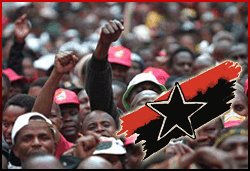 “Africa today lies prostrate, bleeding, and embattled on all fronts, a victim of capitalist and, to a great extent, state socialist ambitions. The heart-rending misery of its peoples, the conditions of abject poverty, squalor and disease in which they live, exist side by side with the wanton luxury, rapacity, and corruption of its leaders.”
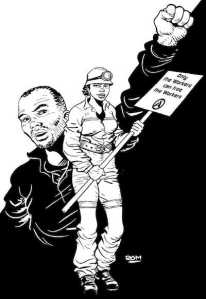 I-Syndicalism uhlelo oluzama ukwehluka kunezihlelo ezejwayelekile zokuphatha nemibuso, ngamanye amazwi i-capitalism nohhulumeni. Ekuqadeni uhlelo lwe-capitalism ubukhomanisi badala into esabeka kakhulu ngokubeka amandla omnotho ezandlani zikehhulumeni kuphela. I-Syndicalistm ishiya emuva zonke izinhlelo zokuphatha esezidale ukucindezelwa noku xhashazwa komuntu ngomunye umuntu futhi. I-syndicalism ibuye izame ukwakha inhlangano eyakhiwe phezu kwezidingo zabantu hhayi izifiso zeziphathimandla futhi eyakhiwe phezu kokubambisana kwabantu abazibusayo, abalinganayo okubhekele ekutheni izidingo zika wonke wonke zifezeke, hhayi zabasezikhundleni.
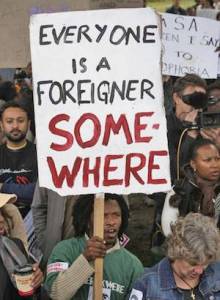 Attacks on African and Asian foreigners flared up in South Africa twice in 2015, first in April, mainly in KwaZulu, then in October in Grahamstown, the Eastern Cape. Many attacks were on small (spaza) shops run by foreigners. Maybe 500 were displaced in October.
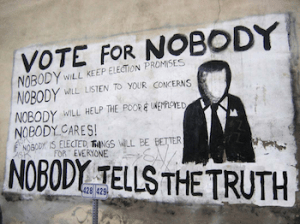 Many in the working class hope the 2016 local government elections will prove a turning point. The ruling African National Congress (ANC) won the 2014 elections easily, but its grip is weakening. The ANC-allied Congress of SA Trade Unions (COSATU) has split, the radical metal union NUMSA expelled. The ANC could even lose control of at least one of giant “metro” municipality in 2016, possibly greater Johannesburg or Nelson Mandela Bay – probably to the moderate Democratic Alliance (DA), not the ANC breakaway, Economic Freedom Fighters (EFF).
 zabalaza.net